Friday, September 30, 2005

Friday cat blogging

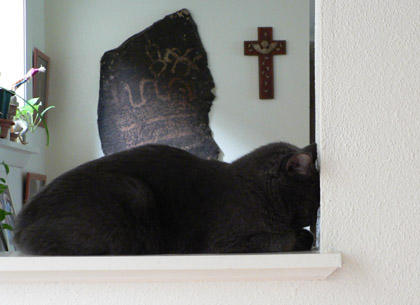
Gray watching a small dog on the floor


and Grendel wanting outta here

Thursday, September 29, 2005

Pilot fish, blood in the water, and economic reform

Having once, in a distant and hard to remember past, been an economics student, I still find myself drawn, every day, almost against my will, to various online financial pages, where invariably, as today, I encounter claptrap about "economic reform."

Why is it that the rulers of the world, presumably under the guidance of their economists, who function much as the paid clerics of Saudi Arabia, universally use the word "reform" to mean programs that make the middle class poor, the poor poorer, all but the very few insecure in their livelihoods, uncertain of their retirement, and fearful for the prospects of their children, even as the already astonishingly rich get unimaginably richer yet?

These water-carriers for an increasingly nasty and brutal social order, which would certainly include a majority of economists since Keynsianism disappeared from the earth, have by and large returned to a 19th century social Darwinism, which, then as now, cloaked unapologetic ideological propaganda on behalf of the rich and powerful in a peculiar imitation of science, nowadays reinforced with a fishwrap of impenetrable mathematics, as if we will thereby take these economists at their word and no one will notice the blood spurting from under the wheels of globalism's juggernaut. Or if we notice, perhaps the mathematics makes it look enough like physics that we will take the operation of the juggernaut to have the inevitability of a law of nature.

If we can be convinced by the pilot fish that a vicious economy, like a great white shark, is kinda the way it's spozed to be, constrained and directed by inevitiable laws of nature, the blood in the water may still turn our stomachs, but we will be resigned to not trying to do anything about it.

But in fact, just about every nation of the world that has achieved prosperity and a decent life for its people has done so precisely by meddling with these imaginary economic laws of nature. Every place on earth that is now, or ever has been, a decent and civilized place for people to live, has gotten to that condition by interfering, sometimes quite markedly, in the operation of the free market.

The Thatcher/Reagan/Bush I/Bush II counter-reformation against human civilization has set itself the task of rolling back mankind's lot to the mid 19th century, at the very least, and has succeeded to a degree no one could have imagined before the conspiracy was joined. Never mind that the brutality of their chosen golden age, a world of workhouses and imprisonment for debt and the billowing smokestacks of Blake's dark Satanic mill, produced Marx and unrest and revolution and, eventually, the most terrible wars the world has ever known, and all-in-all a sea of endless trouble.

But we still have empty suits blithering about economic reform as if it were a _good_ thing. Seemingly the people who actually advocate economic reform think that they have tarted up rightwing ideology enough that we will really mistake it for science, and will believe that such reform, if it is unpleasant for some, is somehow a setting-free of more or less inevitable natural processes, a restoring of an ecological balance, like re-introducing wolves into Yellowstone. Hard on the sheep, but, hey.

What silly crap. Who would believe that impoverishing the middle class is a good thing, whether you call it "reform" and pretend that God, or Science, has spoken, thy will be done, or you simply and correctly call it a great organized conspiracy of the rich and powerful to steal everything there is and make themselves the lords of the earth forever.

But then who would have believed that George Bush would still be talking about tax breaks for the idle heirs of people who die worth billions, and that his congress would at the same time be trying to find turnips to squeeze blood out of to pay for George's War and FEMA's incompetence?

Wednesday, September 28, 2005

So who will go to jail in the latest torture scandal?

Update on the 82nd airborne prisoner abuse. Quotes are from the New York Times:

The Army captain who tried in vain to go up through the chain of command with revelations of torture at an 82nd Airborne base in Iraq, and who then talked to several senators and Human Rights Watch, is now being threatened with prosecution. The captain, Ian Fishback, met with lack of interest at best, and hostility at worst, in his attempts to have the torture problem investigated and corrected. That is, until Human Rights Watch released its report.

Then the investigators leapt into action. Captain Fishback was suddenly ordered to see the investigators and underwent six hours of questioning.
"They're asking the same questions over and over again," [Fishback] said. "They want the names of the sergeants, and they keep asking about my relationship with Human Rights Watch."

Captain Fishback said he has refused to disclose the names of the two sergeants - one who has left the Army and another who has been reassigned - because he promised not to disclose their identities if they came forward. But he said his command told him Tuesday that he could face criminal prosecution if disobeyed its "lawful order" to disclose.
Fishback said the the investigators, from the Criminal Investigation Command and the 18th Airborne Corps inspector general, had expressed little interest in the names of the soldiers who committed the abuses, but wanted only the names of the other whistleblowers. This is certainly not encouraging. You could almost think an effort at intimidation and a coverup is going on.

Captain Fishback said he had no regrets about coming forward, adding, "It's the right thing to do." Let us hope that he does not end up in jail for it.

Tuesday, September 27, 2005

Faith and social pathology

The current issue of the Journal of Religion and Society has an interesting article which, if social science were written in English, would bear the title "Does religion make you stupid?" The actual title is "Cross-National Correlations of Quantifiable Societal Health with Popular Religiosity and Secularism in the Prosperous Democracies." It's by Gregory S. Paul, and if he were a sociologist you couldn't fault him for choosing the title he did; an academic needs to make a living. But I think he is the Gregory S Paul who writes popular science books on dinosaurs, in which case the title is inexplicable.

A majority of Americans, and all of our candidates for political office, believe implicitly in the words of Ben Franklin, that “religion will be a powerful regulator of our actions, give us peace and tranquility within our minds, and render us benevolent, useful and beneficial to others.”

I got this quote from Paul's article, and the gist of Paul's thesis is that the facts don't bear out Ben Franklin's claim.

America is the most religious country in the developed world, by far. We also have more social pathologies, by far, than any developed country. Paul has collected the charts and graphs to prove it.

Japan, France, and the Scandinavian countries are the most secular nations of the world. The United States, by various measures, displays levels of religiosity otherwise found only in third world countries. Americans, unlike people in every other developed country, tend to doubt or reject evolution. This is untrue in the Western democracies, and in Japan. Japan has the highest levels of acceptance of evolution.

The United States is the only developed country with a third-world murder rate. American adolescents get infected with syphilis and gonorrhea at third world rates. Adolescent abortion rates go hand in hand with disbelief in evolution, and with "increasing belief and worship of a creator." Early adolescent pregnancy and birth in America is "two to dozens" of times higher than in secular democracies. Teen-age abortion rates in the United States are more than twice that of atheistic Denmark, where only slightly over 10% of the public claims to believe in God.

Religiosity correlates with positively with juvenile and young-adult mortality, i.e., our young people die or get killed more often than in secular countries.

We are not only the most religious country in the first world, we are also the richest, leading Paul to comment that "The U.S. is therefore the least efficient western nation in terms of converting wealth into cultural and physical health."

This is interesting. What Paul means by "religion" is fundamentalist Christianity, as anyone can see by the proxies he uses: strong belief in a creator god, disbelief in evolution, frequent religious service attendance, and scriptural literalism. The same markers would probably work for most kinds of fundamentalism, actually. World-wide.

Now he does not come right out and say religion causes stupidity. He says, rather, we need more research on possible cause and effect linkages. I don't disagree with that.

Obviously, though, an alternative hypothesis for the same data would be that inequality and racial injustice make you stupid. Personally, I think that may be more of a cause of the social disfunctions Paul mentions than fundamentalist religion, and that these disfunctions are good indicators of unhappiness, which would then be the cause impelling our people to grasp at religious straws to palliate an otherwise wretched life. This sounds Marxist, I realize. But when Marx spoke of religion as an opiate, he must have been thinking of the Anglicans around him in the reading room of the British Museum. The religion of Jerry Falwell is more like crack cocaine.

To get back to the question of what causes what, it's certainly possible for inequality and racial injustice to be part of a nasty feedback loop with fundamentalist religion. I'd guess that explicit research about that could get you denied tenure in many public university sociology departments, or endanger the grant-attractiveness of departments where the researcher already has tenure. I expect not to see a definitive answer.

Monday, September 26, 2005

War as pornography

As many in the blogosphere no doubt know, there seems to be a porn site which has become a repository for GI trophy pictures of Iraqi dead. The rules of the porn site as I understand it are that access to the pornography requires either money or the donation of a picture, which I guess is the reason for the pictures of the dead Iraqis. There are lots of photos of the dead, found, as of today at least--I suspect it will soon disappear--at http://www.nowthatsfuckedup.com/bbs/forum23.html

A more appropriate url cannot be imagined.

They are pretty gruesome, these pictures. The premise of the site is even more gruesome.

I resisted the temptation to put some of these photos up on my blog. But as disgusting as the site is, I think it would be a good idea for Americans to look at them. Modern weapons of war do terrible things to their victims. We unleashed this mayhem.

The trouble is, I fear Americans are now so desensitized to gory movie violence, that viewing this may not be sufficient to awaken in the viewer a civilized response of repugnance, much less a morally necessary and desperately evaded response of contrition.

Maybe in some it would. Perhaps the bizarre and kinda American location of the pics as tokens of admission on a porn site would shock supporters of the war more than the pictures themselves. Maybe. I don't know.

The dismemberments and mutilations shown in the photos actually didn't surprise or horrify me. What horrifies me is that these images represent what are, or were, real people, not so long ago, probably loved and needed by other people, who are now bereft. When someone has had his head blown off, the problem is not how ugly it looks, the problem is that his life has been cut short and other people, who cared about the person killed, have had their lives shattered.

But the ugliness of the pictures could perhaps do some good if viewed in Republican households.

I am hoping the site stays up, and that people start looking at it. Not you, good readers, who are almost guaranteed not to be the people who need to see it.

But the sanitized war, where (to give an example many of you may remember) the shooting of a wounded prisoner of war was filmed by a tv cameraman, but not actually shown on tv for fear of offending, has been sanitized long enough.

Hide the coffins. Hide the bodies. This has been how Bush and company have hoped to evade the revulsion that attended the death and destruction shown on tv every day during the Vietnam War. Keep this war secret. The real war, as it really is.

This porn site is kind of like leakage around a poorly constructed levee. I suspect someone official will try to patch up the leak pdq, or the war may be in trouble.

Sunday, September 25, 2005

Torture and the whited wall

There seems to be a meme going around, which is: go back to the 23rd post on your blog and find the 5th sentence, and post it here.

Well. That's easy. The 5th sentence of my 23rd post was "We're not like that."

To explain these words, I have to take you back to the fourth sentence, which was about cultural differences between us and others. "Ifn you go someplace else (nuther culture, we say, approvingly, widening ourselves) and eventually it dawns on you that these other people (Paraguayans,in my case of nuther culture) don't personally give a shit whether I think this way or live that way, but watch out they say, helpfully, don't let the government think you're a commie or they'll grab you and push you out of an airplane." End of sentence the fourth.

I was talking about how we, the Americans, are a little different from a lot of other people, not in that we are cruel, because other peoples are cruel as well, but in that we have a streak of fanaticism in our cruelty that was perhaps lacking in cases like the militares of the Stroessner regime in Paraguay, who would take dissidents up in a DC-3 with the cargo door open and push them out over the Chaco, but not with any personal hatred, or so I am led to believe by some accounts I have read. You may take any part of the foregoing with a grain of salt, if you wish. Or not.

We see in the instance of the most recent revelations of American cruelties in Iraq that our crimes against humanity are different from the indifferent enforcers working for former Paraguayan President Stroessner, and spring from equal parts of fear and fanaticism.

The 82nd Airborne is, or considers itself to be, an elite Army unit. Three soldiers of the 82nd have recently gone public with elaborate and, in my view, convincing testimony of systematic torture of Iraqi prisoners. Their complete statements were published by Human Rights Watch, and picked up by Time and the New York Times. I have just read all 3 accounts.

The reason their stories are getting noticed may be that they are members of a highly trained regular army unit, and their chain of command was clearly well aware of what was going on. The "bad apple" AKA the "badly trained rogue reservist" excuse goes by the board here.

Compared with known instances in which our soldiers have tortured or beaten prisoners to death in Iraq and Afghanistan, their revelations are relatively mild stuff.

A little torture terminology here: A prisoner was called a PUC, meaning Person Under Control. To beat a prisoner was to "fuck a PUC." To "smoke a PUC" was to exhaust a prisoner through physical labor or forcing him into painful physical positions to the point where he passed out.

And the third-grade Manicheanism peddled by our highest public officials, whereby enemy partisans are called "the bad guys" was almost standard issue in the mouths of these soldiers. They seemed to share with a lot of Americans a belief that our enemies are evil. And, quite understandably, more so than for our civilian Republican population, they were consumed with fear.

So fear and fanaticism were two of the ingredients of the torture they reported. But there was a third. They were told by their superiors that the Geneva Conventions did not apply to these prisoners. That's why PUC replaced POW. A vague lip service to "humane" treatment became the only standard, and that standard became an explicit joke. Humane treatment meant that anything goes if you don't kill them.

The company cook could come in and work out the stress of his day by beating a prisoner, in an instance recounted, by breaking the prisoner's leg with a metal baseball bat.

Where did the explicitly vague "well, we can't really tell you, exactly, what the rules are" rules come down from? Well, from the office of the White House consigliere, now the Attorney General, and from the office of Secretary of Defense Rumsfeld.

Now, in the minds of our people, so strongly predisposed towards good vs evil fanaticism, and who find themselves in fearful circumstances, how will these guidelines be construed? Well, we see in the soldiers' testimony exactly how.

Thud. "Hey, take it easy man. You can fuck him, or you can smoke him, but be sure you don't kill him."

I am guessing that the 23:5 meme refers back to Acts 23:5, where Paul says--sardonically I have always assumed--after having been reproached for calling the High Priest a whited wall, "I realized not, brethren, that he was the high priest: for it is written, Thou shalt not speak evil of the ruler of thy people."

There is an interesting recursive complexity to Paul's words viewed in the context of the present meme, given the popularity of Paul's own Manichean fanaticism with the followers of the ruler of our people, which makes my head hurt when I think about it.

update:
Think Progress reports that Bill Frist is involved in the coverup of the fuckapuc torture scandal. He, along with Sen. McCain, was one of the two senators contacted by one of the soldiers who reported it, an Army captain. McCain's response was to file a resolution to make the military rules of conduct towards prisoners clear. Born-again Christian Frist's response was to torpedo McCain's bill.
On July 27, the same month the Captain came forward, Sen. Frist single-handedly derailed a bipartisan effort — led by Sen. McCain — to clarify rules for the treatment of enemy prisoners at U.S. prison camps. In what news reports at the time described as an “unusual move,” Frist “simply pulled the bill from consideration” before it could be debated.

update II:
According to Scott Horton, the Army investigated itself about torture allegations. A Major General Fay was in charge. He is a Republican Insurance executive and reserve officer, who was called up for the purposes of the investigation/whitewash. Fay's investigative technique was this:
Fay repeatedly warned soldiers that if they were involved in incidents, they would be put up on charges. And if they had seen things and not reported them, they would be up on charges. Then he asked if the soldiers had anything to report.
Friday, September 23, 2005

Thursday, September 22, 2005

Mr. Bush, meet global warming: II

The belief that science can be replaced with spin is a religious belief that is more catastrophic in its consequences than one that the world is 6000 years old. Although the latter belief, and similar ones derived from literal faith in Christian scripture, is held onto tightly, with eyes tight shut, by the Republican base, the Republicans in charge, who imagine themselves masters of the world, are no doubt as cynical about such articles of ordinary Republican rank-and-file peon faith as they are about science.

In essence, the religion of the would-be masters of the universe is political power, and the intensity of their own faith is such that they have dispensed with "reality" as being, well, outmoded. They are kind of like the Maoists of years past, who believed that power grows from the barrel of a gun, and who, as a corollary, believed that cultural revolutions and great leaps forward could simply be willed, and made to happen, with brute political force. Republicans have a similar view, it seems, about physical reality.

Physical reality, obviously, has other plans.

Global warming can't be spun away. This hasn't really sunk in for Karl Rove and the neocons, I suspect. They haven't really noticed that their own great leap forward is running up against physical, and logical, constraints. Reality, whether physical or fiscal or military, doesn't actually change if you try to hide it with smoke-and-mirrors. Lyndon Johnson and Robert McNamara and Richard Nixon and Henry Kissinger showed that you can pretend to win a war when you aren't winning it for 10 years, but, eventually, reality wins.

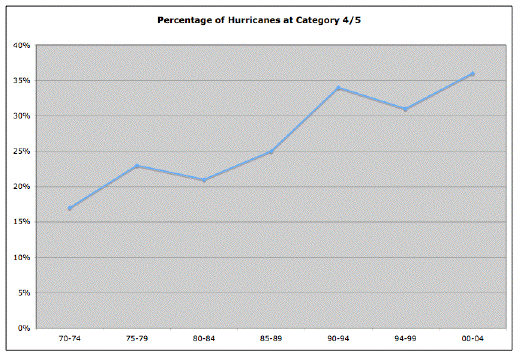
An interesting post by Stuart Standiford in the Oildrum blog, has this remarkable graph, based on a study by Webster, et al. in the 9/16/2005 issue of Science.

Although global warming has not increased the frequency of hurricanes, it seems to have increased their intensity, as the Kerry Emanuel paper I mentioned in a previous post shows, and here we see an amazing upward trend in the percentage of category 4 and 5 hurricanes in the past 30 years. This is true worldwide--in the Pacific and the Indian Ocean, as well as the Atlantic. The percentage of such storms has doubled in that time period.

Once you realize that global warming is going to have unpleasant, but to a some extent knowable, consequences, you can prepare for that. You have to think in a new way about disaster preparedness, for one thing. You have to harden certain infrastructures like levees. You have to move away from an oil and gas economy, especially when one quarter of our oil and gas comes from the Gulf of Mexico. (There are other reasons for doing that, ultimately more compelling, having to do with peak oil.) The Bush administration is absolutely unwilling to do these things, preferring talking points to science.

Bush and Rove and the the right wing punditocracy who think agitprop and spin can overcome reality will run into the same thing that believers in cargo cults did. Reality doesn't respond to faith-based initiatives. Unfortunately, the damage these people do is about the only tangible thing that will emerge from their delusions.

Wednesday, September 21, 2005

Thinking about Rita

As of a few minutes ago, Rita is a category 5 hurricane, with sustained winds of 165 mph. The National Hurricane Center 2:55 update is below.

WTNT63 KNHC 211955
TCUAT3
HURRICANE RITA TROPICAL CYCLONE UPDATE
NWS TPC/NATIONAL HURRICANE CENTER MIAMI FL
255 PM CDT WED SEP 21 2005

DATA FROM RECONNAISSANCE AIRCRAFT INDICATE THAT RITA HAS REACHED CATEGORY FIVE INTENSITY WITH ESTIMATED MAXIMUM SUSTAINED SURFACE WINDS OF 165 MPH. THIS WILL BE REFLECTED IN THE 4 PM CDT ADVISORY.

Austin is pretty far inland, but if the hurricane stays on the projected track we'll be getting winds of 50-75 mph and a considerable potential for local flooding. Since I live too close to Onion Creek, this concerns me. Also, the TAOS hazard model gives us a good chance power outages of unknown duration. So, this afternoon I will be getting some new batteries for flashlights and radios. But mainly, the hazard those of who live on Onion Creek face is enough rain to put the creek really high out out of its banks. This has happened during hurricanes in the past, in fact the most severe recorded floods on the creek have been due to rains from stalled hurricanes. Having almost been caught in my house during the last flood, I will probably evacuate with my daughter and the dog and the cats on Friday, if things still look bad locally.

My hope, of course, both for myself and the people who live on the coast, is that the the hurricane diminishes in intensity in the next couple of days. Supposedly the water in the western Gulf is a little cooler than the water where it is now, which will decrease wind speed and storm surge.

A direct hit on Galveston by a cat 5 hurricane would very likely be a real disaster.

Let us hope for cool water in the Gulf of Mexico.

Tuesday, September 20, 2005

Secrets of the graveyard

I wrote a short piece here about two cemeteries in Austin. Meditating in cemeteries is an ancient Buddhist practice, which is not why I visit graveyards, but, as a Buddhist, the existence of Buddhist scriptures 2000 years old recommending it enables me to claim some spiritual reason for my habit of walking in cemeteries--provided I am willing to break the 4th Precept, which forbids lying. In other words, it really isn't the reason.

But it sounds like a good thing to do, going to the graveyard and meditating on life's transience. I have on a few occasions undertaken to do just that, but have been driven out by mosquitoes or leaf-blower noise or widow ladies scowling at me as they brought flowers for Fritz's grave near where I was sitting. So it doesn't work. But I like the idea, even if it doesn't pan out for me personally.

What I like about graveyards is the lives you just have glimpses of, or can imagine, maybe from a hint on the tombstone inscription. Not to mention the lives of the living, the widow lady with the flowers, and the man who waters the grass on his wife's grave, or the old man who runs the cemetery association that owns Live Oak cemetery where my wife is buried, who unfailing complains to me, when I run into him every few months, that my wife's grave is too cluttered and disordered.

Plus I like the esthetics, usually austere but sometimes, as in Mexican graveyards, the opposite of austere, and I like the landscaping, or the lack of it, and the astonishing cultural specificity and conservatism--up until recently, anyway, of funerary customs and art. For one example, that I saw yesterday, the Texas-German tombstones decorated with pre-Christian hex symbols, that the stonecarvers probably had no idea of the origin of.

Yesterday I walked in the old Oakwood Cemetery in downtown Austin, which was the big municipal graveyard for a hundred and fifty years (full up, now), and the prestige place to be buried. Lots of obelisks and marble mausoleums. I tend to ignore those.

I also found this--I haven't had time to try to find the story that goes with it. If past experience is a guide, I won't be able to. I was looking at the old Beth Israel portion of the graveyard, and noticed the stone below:

Elias Olenick's tombstone

Elias Olenick, native of Poland, age 38 years 8 months, murdered at Austin December 13, 1877. May his soul rest in peace.

This is very unusual--not to get murdered, in Texas--but for a tombstone to give the cause of death. For the most part, Jewish graves in Texas are undistinguishable from Anglo protestant ones, except, sometimes, for the lettering. The overall look, from a distance, is the same. Jews, at least Texas Jews, seem to have taken pains, in death, to fit in with their neighbors, unlike every other cultural group, which tried to preserve its differences, and unlike the dominant cultural group, white protestants, who, to everyone's great misfortune then and now, didn't give a rat's ass about their neighbors.

But I digress. A quick search on the web, not the best place for this sort of thing, turns up only that he was a shopkeeper, who was murdered in his dry goods store. No details. I'll put it on my list of things to look up next time I go the the downtown public library, where there is a cardfile index and microfilm archive of the Austin newspaper for the 1800s. Still not something you can look up on a computer.

I would not bet on being able to find out the story. Old Texas newspapers were laconic about this sort of thing, except in cases where a minority member, unstead of being the victim, was the accused.

I am guessing--in the total absence of information--that Elias was either murdered because he was Jewish, or that his murderer was set free because his victim was Jewish, and that the inscription, which as I said is highly unusual, was a small but more or less permanent protest. I'll let you know if I find out anything one way or the other.

At the far end of the cemetery from the old Jewish section is Baylor Baynham Palmer's grave--I stopped by it to see if I could get a photo, but the light was bad and the inscription, obscured by lichen, was not legible. But the tombstone says, on one side:
Baylor Baynham Palmer
Born [illegible] Virginia, died 1885
Captain of Artillery under General Lee
This cross [ with x inscribed in stone] was on his forehead,
this star [inscribed star] stood over him
He tried to be his brother's keeper and failed
and hid himself under the name of
The Lone Palm Tree

At the top of the stone, are two crossed palm fronds. On the other side, at the top of the stone, the name on the stone is "Lone Palm Tree."

I did search the local paper archives for the Lone Palm Tree, and found his death notice, but it said only that he was a beekeeper. I am guessing post traumatic stress syndrome, and suicide, but, who knows? The secret of the inscription could be anything. And--too bad for nosy people like me--the secret is probably lost forever.

Sunday, September 18, 2005

The road to serfdom

I am offering a few remarks today on the last David Brooks column I will be able to read at a fair price, and very likely the last David Brooks column I will ever feel obliged or even tempted to read, given that the New York Times wants $50 a year to read their op-ed columnists, starting tomorrow. (I'll miss Krugman, but I wouldn't be surprised if he finds another venue, whether by being fired or by looking around one day at the company he is keeping, and deciding to move on.)

Brooks in his over-the-top effusiveness today sounds like like he is channeling a Pravda editorialist after Uncle Joe announced the Hitler-Stalin Pact. I mean, you'd think Brooks had been listening to the Gettysburg Address or the Sermon on the Mount. Now what Bush actually said, was that he proposed to open the floodgates of wealth to Halliburton and Bechtol in rebuilding New Orleans even as wages are cut and public schools are shut down. The rush of the heavyweight porkers to the public trough could be heard as a low, if metaphysical, rumble providing the true musical accompaniment to Bush's speech. For Brooks, that's the music of the spheres.
Bush proposed an Urban Homestead Act, which will draw enterprising people to the area, giving them an opportunity to own property so long as they're willing to work with private agencies to put up their own homes. He proposed individual job training accounts, so much of the rebuilding work can be done by former residents. Children who have left flooded areas will find themselves in a proto-school-choice program, with education dollars strapped to each individual child.

What does this mean? Well, substandard wages, and school vouchers. Brooks cannot fail to be cheered by the clear and obvious impossibility of a person working for the proposed sub-minimum wage pay scale to be able to buy one of the replacement housing units in the new and nicely gentrified New Orleans. So we will have the best of Brooks's possible worlds, a nice, southern white, Republican New Orleans. No wonder he was so ecstatic at Bush's speech.
This is an effort to transform the gulf region, which had become a disaster zone of urban liberalism. All around the South, cities are booming, but New Orleans never did. All around the country, crime was dropping, but in New Orleans it was rising. Immigrants were flowing across the land in search of opportunity, but as Joel Kotkin has observed, few were interested in New Orleans.

Translation: New Orleans was full of poor black people, criminals who voted democratic. This changes everything. Hurray!
Now the Bush administration is trying to change all that. That means trying to get around the corruption that made the city such a rotten place to do business. The White House is trying to do this by devising programs in which checks and benefits flow directly to recipients, not through local agencies.

The "direct recipients" of which Brooks speaks would be Halliburton and the friends of Mr. Allbaugh, who are, as we already see, busy on the ground.
His administration is going to fight a two-front war, against big government liberals and small government conservatives, but if he can devote himself to executing his policies, the Gulf Coast will be his T.V.A., the program that serves as a model for what can be done nationwide.

Translation: Irresponsible spending AND even lower taxes.

There is kind of an astonishing chutzpah here, even for Brooks. I guess it goes with the job, and is what it takes to imagine that heaping syrupy prose over a plan to "help" poor African Americans by paying them slave wages, and to house them in a trailerhouse shantytown while they do the heavy lifting, will hide the bitter truth. And after the reconstruction is done? Well, in tandem with the new bankruptcy laws which assure that, if they fall into bankruptcy by, say, by defaulting on the mortgages on their houses that have been bulldozed but that they still have to make payments on, or if they can't pay their medical bills if they fall off a scaffold, they will live the rest of their lives with their sub-minimum wage paycheck being garnished by the courts, in a state of perpetual indentured servitude. The old name for that condition is serfdom.

And it will be a roadmap for the future of not only America's poor, but of America's one-time middle class.

The deluge will come later.

Saturday, September 17, 2005

A visit to two cemeteries

Friday afternoon I drove past a little Mexican graveyard in south Austin, Cementerio María de la Luz, near my house, and since I had my camera with me, I decided to stop. Mexican cemeteries are beautiful. Actually, cemeteries of all kinds are, in one way or another, emotionally powerful and moving. But Mexican cemeteries are what I would call beautiful. I took a few photographs. Then I went on my way to the old, much larger so-called Anglo cemetery, the Boggy Creek graveyard, where I often go birdwatching.

I don't think the difference between the two is as much a view of death, as a view of life. Old "Anglo" cemeteries in Texas tend towards the grim and austere, though not so much as in New England. You won't find winged death's heads and "prepare for death, and follow me" verses on old Texas tombstones. Instead you will find sentimental doggerel or bible verses. But the overall look is still in the vicinity of the plain and unadorned. And there can be a certain loveliness to it.

Even though I began with a mention of the Mexican graveyard, I'll first show a picture of the Anglo cemetery, because I want to end this story with remarks about a grave in the Mexican camposanto.

Boggy Creek Graveyard.


There is a sad story at the beginning of the Boggy Creek graveyard, as with all graveyards, but this sad story survives: John Davis, in 1859, was part of a wagon train of occasional lumberjacks traveling to the pine forest in Bastrop, 30 miles away from Austin. They were camped along the way, and during the night John was sprayed by a skunk. When he ran shouting, possibly cursing, through the camp, he was mistaken for a Comanche raider and shot and killed.

His father, Jenkins Davis, who owned this land, brought his son back and buried him here. From our distance of a century and a half you could call it a funny story, for a moment at least, but I'm sure Jenkins loved his son as much as any of us love our own children.

Other settlers in the Manchaca community nearby were buried here. One of my Grandfather McCulloch's first cousins is here. By now it has about 1500 occupants. It's near my house. The reason I go birdwatching here is that it's quiet and little visited, and surrounded by a scrub cedar forest on 3 sides. It's owned by a Masonic lodge, which has far more members buried here than presently show up for meetings.

Cemetery shrike


To return to what should be at the beginning, in a properly written story, all we know of the origin of the Mexican graveyard is that a little girl, María de la Luz, daughter of some people traveling through, died and was buried here in 1912. (Most of the Mexican residents of Texas north of San Antonio were ethnically cleansed after the Texas Revolution in 1836. There were very few Mexican residents north or east of San Antonio until the Mexican Revolution in the early years of the 20th century, the turmoil of which led to a big wave of immigrants.) By the 1940s it had been become the graveyard for the small Mexican community in far south Austin. Like the Boggy Creek cemetery, it is now pretty much full, though both still have occasional burials.

The most shocking difference between the two cemeteries is color. Vibrant, saturated color. I'll let the pictures speak for themselves.
A blue cross


An old grave marker


Painted Jesus


A burial from the 1990s


A final note: I was reading that the Defense Department has begun targeting hispanics for recruitment, because recruitment for whites and African-Americans is falling. They plan to appeal to Mexican cultural norms of male honor and courage, on the one hand, and the desires of all immigrants to be more American than the Americans, on the other hand, to encourage them to join up. Actually, the recruiters have done this fairly successfully for many years. Here, freshly decorated, is the grave of Victor Flores, Lance Corporal, US Marine Corps, who died in Vietnam in 1965 at the age of 20. He would be 60 this year. Somebody tends to this grave, 40 years after his death.

Friday, September 16, 2005

Friday cat and mockingbird blogging

Here's Gray in his favorite niche napping with his head against the wall. Gray is a strange cat. He also refuses to drink water except running from a faucet.


Meanwhile, here's a mockingbird in my back yard, greeting the sunrise

Thursday, September 15, 2005

Wednesday, September 14, 2005

What's the difference between Mike Brown and George Bush?

Well, Brown is not afraid of horses. And Bush, sadly, still has a job. But otherwise, not much, other than the buck having stopped, for the moment, with Brown, who, like President Incurious George, had little interest in the details of governance, preferring to leave that to the underlings who, somewhere down the line, were presumed to have the expertise and conviction to actually do their jobs. Trouble is, you had to go way down the line to find them. They had been replaced with clones of Mike Brown. After--what is it, 5 years of Bush?--the non-governance team had a deep bench.

Between Brown and the President was Mike Chertoff. Under the National Response Plan, he is the guy actually responsible, in the event of a disaster, for declaring an "incident of national significance" which is needed to activate the plan. He did so on the evening of August 30, some 36 hours after the hurricane struck, and three days after the President declared a state of emergency and four days after the governor of Louisiana did so.

The National Response Plan, which specifies that the federal government can and must take immediate emergency action with or without the permission of governors and mayors, is activated only when the secretary of Homeland Security declares an "incident of national significance." At that point, "notification and full coordination with the States will occur, but the coordination process must not delay or impede the rapid deployment and use of critical resources"

Must...not...delay...or...impede...the rapid deployment and use of critical resources. So let's say the governor and the mayor were asleep at the wheel, as the apologists for Bush wish to think. For the sake of the argument, as we say. That does not absolve Bush, Chertoff, and Brown of their responsibilities under the National Response Plan, quoted, in small part, above.

But gee, the Plan (and it's almost impossible for me to keep my fingers from putting quotes around the word) does not seem to have been set in motion until the whole world, or at least the whole world that reads newspapers or watches tv news, or even watches Fox News, knew that there had been an enormous disaster. Chertoff, the guy in charge, waited 36 hours to tell FEMA to swing into action. What was he doing? Well, he was imagining that he read headlines, which, as I have pointed out in other posts, did not exist. Headlines saying that New Orleans had dodged the bullet. Who knows what else he was doing. And what was Bush doing, the evening of August 30? He was in San Diego, declaring "mission accomplished" for World War II.

Sometime that same day, he apparently also found time to create a "task force" to take charge of what Chertoff was already, under the law, in charge of, according to yesterday's Knight-Ridder story on the mystery delay. White House officials are currently unwilling to "explain why Bush felt the need to appoint a separate task force."

I think this may be the evening when Bush's retinue of trained hamsters finally worked up the nerve to tell their boss there was a problem. "No, really, a _big_ problem, Boss." I'll have to check the timeline on that.

But it's Brown who goes to the wall, and deservedly so, given his performance after his boss told him to go to work. But Perhaps Chertoff should follow him. The procedure for firing Bush is very involved and fraught with complications, so we have to forget that, unfortunately, if only because of his designated replacement.

Interestingly, the only agency of the federal government that did its job all along seems to have acted without authorization from anyone, thank God. That was the Coast Guard, which, although folded into Homeland Security like FEMA, has not yet been staffed with people whose expertise is in draping the bunting on the Boss's podium

Tuesday, September 13, 2005

Why the time for the blame game is now

Well, actually, it's not a game. But it's pretty damn important we figure out exactly what went wrong, what was not done, and what could have been done better. And we need to do that while people are still upset enough to do something to make sure those problems are fixed.

Something sure as hell needs to be fixed. Maybe lots of things need to be fixed. And to do that we need to assign blame. It's nothing personal.

Also, this is fresh in our memory. We should not forget the human face of things going catastrophically wrong. We should not forget, or become emotionally dead to the fact, that a great city has been physically destroyed and its inhabitants dispersed, possibly never to return. An unknown number of people have died--many, maybe most, because of avoidable mistakes. If we wait and immerse the nation for six months in the poisonous electronic soup of Fox News, enough people will be saying shit happens, cities get destroyed, so what--let's get back to celebrity trials or who Brad is divorcing now.

It is worth noting, in passing (nothing new, of course), that the people who are saying now is not the time for blame are not altogether honorable in that insistence, inasmuch as they they are fully engaged in blame themselves--of local officials-- which in their eyes apparently does not fall under the heading of blame. Example:
I turned on the TV Monday night and in less than a minute encountered the sliminess of Joe Scarborough up to his hip waders in an unusually oily and toxic blame project (not quite at the mutagenic smoke-and-fumes superfund level of Fox, but still what you might call a neural biohazard) directed at the mayor of New Orleans the very next breath after Joe said we should put aside partisanship and blame. The very next breath. I turned the TV off again. I have had enough.

So how should we assign blame?

First, we ought to ask if the disaster could have been prevented. I think the answer is yes. Surely nobody who believes in American engineering and can-do problem-solving would be so defeatist as to believe that we can't do as well as the Dutch in building levees. Surely nobody thinks we are totally helpless to preserve the marshlands that once protected the city. Many really smart people have for years been proposing both environmental and engineering measures that, if fully carried out, would have left the city intact after a category 5 hurricane.

What do these proposed measures have in common? Two things. They are costly, and they are opposed by the conservatives who control federal spending, and who want to drown government (except wartime government) in the bathtub, kinda like New Orleans got drowned. Maybe that's what Grover Norquist really meant. Drown government. Drown cities. He's the man who invented the doctrine let the cat out of the bag--you'll have to decide for yourselves if that's what he meant.

But I digress--now that we can see what was at stake, if levees and protective marshes cost ten billion dollars, we would say that's a heckuva bargain. So in assigning blame, try--try just as hard as you can-- to imagine the response of the current House of Representatives, Senate, and President to a request (before this disaster) for 10 billion dollars to protect New Orleans. If you can't imagine a favorable response from such people, no matter how hard you try, you are, at least, still sane. As recent history shows, instead of the Corps of Engineers getting billions, they did not even get the $105 million they requested for levee maintenance. It got cut to $40 million. That money was needed for a $400 million dollar bridge to an uninhabited, but nevertheless apparently Republican, island in Alaska.

It's not like we can't afford to spend billions. Look at Iraq. Look at Halliburton contracts. Look at what we are going to dole out to Bechtel and Halliburton and the other favored no-bid contractors to rebuild New Orleans now. Apparently FEMA is already hiring Blackwater mercenaries for combat duty in New Orleans. So we can afford the money. We just couldn't afford what we needed when we needed it. By "we" I mean, well, you know who. The guy who does not want to play blame games.

Second, given the initial mistake, which we will surely now correct, of not protecting the city with adequate levees, we have to ask what could have been done to minimize the human toll of the inevitable flood. Who had the resources to deal with it? Who had the mission, assigned by the laws and directives creating the Homeland Security apparatus, of taking charge in a catastrophe which overwhelms local resources? Who did everybody presume had a plan? Who did not have such a plan, despite the billions spent on homeland security since 9/11?

Who was presumed, under Homeland Security's National Response Plan, to be in charge. Well, as it happens, in that plan, we learn that "The president leads the nation in responding effectively and ensuring the necessary resources are applied quickly and efficiently."

Wow, there's your problem, right there. I don't think we need to pursue the blame game any further.

Well, actually, that's not the whole truth. But that's the essence of the problem. Once we have that truth firmly in mind, we can start looking at specific failures, like those of the sad clowns like Chertoff and the clueless horse-lawyer who has now duly and loyally taken the bullet for his bosses; they, of course, hoping that will be the end of it, and he, no doubt, hoping against hope, that they will reward him with white-collar employment. Somewhere. Eventually.

Then we can start exploring the vastness of the non-plan Chertoff's agency squandered billions on.

Oh, yeah, I think the mayor and the governor had no plan either. Having one would have helped, though I don't see how that alone could have been enough. But I think whoever replaces them--and they deserve replacement--should make sure the city and state does indeed prepare to do better just in case the feds fail to stop another disaster.

And if we don't soon turn the malignant plutocrats and heartless psychopaths and mad-dog religious extremists running the country out of office, we will all need our own personal disaster plans.

Monday, September 12, 2005

Wild Austin: Occasional notes

On my walk yesterday, whose basic purpose was to cleanse my mind of all thoughts of George Bush, and which only partially accomplished that purpose, I took a couple of photos in Seawright Park by Slaughter Creek. The first is of some wild grapes. These are called fox grapes by some people, but are more properly called fall grapes, because the fruits get ripe in late September and October. They are also called uvas cimarronas (which basically means wild grapes) by immigrants from northern Mexico, where the species is also common.

The fruits are very sweet and tasty when ripe (they are almost ripe now), but small with big seeds. Supposedly they make good wine, but the plants are not abundant. You would have to find a way to cultivate them to get enough juice to make as much as a single bottle of wine. I have read that they are difficult to propagate. The vine I took a picture of may be the only one of its kind in a 300 acre park along Slaughter creek.
Another native, the mustang grape, which ripens earlier in the summer, has much larger fruit, and is much more common. Sadly, its grapes are more or less inedible, and its juice undrinkable, no matter how prepared, and god knows I have tried everything myself. The juice is acidic enough to strip paint off furniture, and has essentially no sugar content. If you add enough sugar to make wine, chances are you will either get very powerful vinegar you can use to unclog drains, or wine you will regret, with something beyond what winesnobs call skunky overtones--you get the skunk itself.

You can make jelly out of mustang grapes, but I guess you would have to go further out of your way than I am willing to go to develop a taste for it.

I am probably missing a bet by not capitalizing on healthful properties of grapeseed anti-oxidants and marketing mustang grapeseeds, because mustang grape antioxidants have gotta be industrial strength, high-powered chemicals.

But below is the much better tasting fall grape. I found a few ripe enough to eat. I wish there had been more.

Vitis berlandieri


But here we have a deer, not too far from the grapevine, possibly also waiting for a chance at these grapes.

Sunday, September 11, 2005

A few personal thoughts on 9/11

On September 11 I had just been back at work a day or two, working half days. It was eleven days after Kay--my wife--had been diagnosed with leukemia. I was still sleeping beside her at night in a chair in her hospital room. I think she had just begun her first round of chemotherapy. She was feeling a little better from the life-sustaining treatments she was getting, like blood and platelet transfusions, and had not yet started to feel bad from the chemo. So she felt, in a certain sense, OK, yet she--and I--were just coming to terms with the notion that she might die.

The oncologist had told us that she had about a 50/50 chance of being "cured," which he meant to be a hopeful statistic, but which sounded too much like a coin toss to be taken as such by lay-people like Kay and me. Since the diagnosis I had done a lot of searching of medical databases available on the internet, and had discovered that the oncologist was fudging his numbers somewhat, giving us a statistic uncorrected for my wife's age and the specific subtype of acute myelogenous leukemia she had, which, if taken into account, gave us much less hopeful figures than the coin toss.

I recall coming to a horrible realization at about that time that there were about three chances in four she would be dead within a year.

But in the short run, we were optimistic. Because she had come very close to dying a week before. She was better now, and the chemo would certainly knock back the leukemia, if not eradicate it. Optimism is the wrong word. We were relieved that she had survived the immediate crisis of the week before, but we were suddenly thinking of her future life, our life together, in weeks and month, not years. Which was a very odd transition, from a week and a half before, before she had gotten sick.

This is the context of 9/11 from me. When my boss told me what was going on that morning, I said I'm going back to the hospital, I need to be with my wife. I don't think I came to work for several days after that. Kay and I watched the horror on the TV in her room, footage imprinted on all our minds that--sort of by common agreement, it seems--is never now shown, except maybe once in a great while a you will see a photo. I don't think I have seen any video footage in 2 or 3 years.

We were still trying to absorb the danger that Kay faced, and you might think that it made us more aware of the human import of what was going on than we would have otherwise been. In a way it did, but no more so than for everybody else in America, I think. The raw edge fear and loss that surely was felt by people on the scene, and of people who had loved ones killed or missing, and of people who feared for the safety of friends, was right there for us. Kay's room felt like she was in the world trade center and we did not know if she would get out. So that made us closer to it. But somehow I think everybody felt that. Leukemia had little to do with it.

I remember thinking , and I remember Kay mentioning it too, that there is a difference between real loss and symbolic loss. For a while, I think all across America, symbolic loss, the words of the talking heads, got overwhelmed by real loss, inescapable in the images. Real loss is personal and one-by-one, and the significance of 9/11 to me is that for a while most Americans knew the difference. It was probably most acute for me in seeing the people who jumped. Kay and I had already taken refuge in the idea of weeks and months of life left--the people who jumped had seconds.

Kay and I were pretty much like the rest of America--her 8 1/2 months to live was infinitely longer than the 6 or 7 seconds of free fall from the burning offices--and we all were helplessly transfixed by those few seconds.

Earlier today, I just got a glimpse of some ceremony in Washington, with people I won't even name standing solemnly at attention, with flags, bunting, and taps played on a bugle. Symbolic loss, used by the worst of men, for the worst of purposes.

Saturday, September 10, 2005

Just exactly what kind of camps are these?

I have just read an interesting first person account of a visit to a camp for evacuees being set up in a remote mountain church camp in Oklahoma. The author, who unfortunately is not identified, tells of a thwarted family effort to deliver supplies to the camp shortly before evacuees were scheduled to arrive.

Possibly I am being punked here, but it looks to me like the article is authentic--for one thing the author has a lot of pictures of the trip, including some of the Oklahoma Highway patrol guarding the gates, and seems familiar with the camp by virtue of being a member of one of the churches with cabins in the camp. ("Cabins" seem to be steel building dormitories, in some instances at least, perhaps one of the reasons the place was chosen.)

They ran into a lot of obstacles. In fact they were only allowed in only because of some confusion as to whether they were authorized charity workers. The family's offering of clothing was rejected, possibly reasonably, on the grounds that there was plenty of clothing. But milk, food (except pop tarts), and toys were disallowed also.

Apples were rejected for the following reasons:
It looks like you've got about 10 apples there. I'm about to bring in 40 men. What would we do then?"
My mother, in her sweet, soft voice says, "Quarter them?"
"No ma'am. FEMA said no...It could cause a riot. You don't understand the type of people that are about to come here...."

OK, part of this is just bureaucratic stupidity, to be expected, but the riot business is beyond stupid--it's racism, pure and simple.

Besides racism, or as an adjunct issue to is, is the question of whether this, in a remote area of the Arbuckle Mountains, is a de-facto prison.

He (the FEMA guy) then proceeds to tell us that some churches had already enquired into whether they could send a van or bus on Sundays to pick up any occupants of their cabins who might be interested in attending church. FEMA will not allow this. The occupants of the camp cannot leave the camp for any reason. If they leave the camp they may never return. They will be issued FEMA identification cards and "a sum of money" and they will remain within the camp for the next 5 months.


If what the FEMA guy told the author of the article is true, sounds like the occupants of the camp will, actually, technically, be allowed to leave, but on the condition that they not come back. Moreover--think about this--this place is in the middle of the Oklahoma mountains, 3 miles from the nearest house, and 8 miles from the nearest town, which itself has a population of 2000 people.

So even if the people _wanted_ to leave, how could they manage to do it? Walk down the road and thumb a ride? From who? So they walk 8 miles to town? Then what?

There is something basically wrong with this FEMA dispersal of the New Orleans population. I have also read about a relocation camp in Utah, of all places. Why can't the people evacuated from their homes be placed nearer to New Orleans than the Arbuckle Mountains, or Utah?

I know there are unused military bases closer to New Orleans than these places.
And no matter where they are sent, they should not be treated like prisoners, and kept behind guarded gates. The function of guarded gates, in this context is either to keep prisoners in, or keep reporters out.

Neither should be the case.

Friday, September 09, 2005

Is it respect for the dead, or an effort to hide reality?

Our government doesn't want pictures taken of the dead, out of respect for the survivors who might discover uncle Joe's death in a truly shocking way, from a newspaper or TV image. Normally I would have some sympathy with this, and I could understand this wish if expressed by a normal government headed by a normal president, but in this case it is more like an accused axe-murderer not wanting the jury to see the results of his work, than it is like respect.

Idyllopus in Meanwhile Back at the Ranch writes:
First we were told hundreds, maybe thousands. Then we were told thousands. Then we were told 5000. Then we were told 10,000. Then the news was that FEMA was delivering 25,000 body bags.
But DMort is telling morticians to prepare for 40,000 bodies.

At some point Mr. Bush and his hirelings are going to have to start telling us how many people they allowed to drown. Or is that going to be postponed indefinitely while we get down to the hard work of repairing Trent Lott's second home? Our this-is-hard-work president has already mentioned wants to be able to sit with Trent and reminisce and make jokes about the President's binge drinking in New Orleans in the old days, wistfully drinking diet cola while the Senator sips mint juleps on his renovated front porch. I hope I am exaggerating--Bush only mentioned that he wants to be able to sit with Trent on his new front porch, so I am just guessing, based on his behaviour during his New Orleans photo-op tour, as to what he will talk about.

I have never been able to lower my expectations enough to match the real-life performance of this sad occupant of what was once Abraham Lincoln's house.