Saturday, January 29, 2011

Birth of a Nation

I had never seen Birth of a Nation. I don't know why I watched it, I guess it came up when I was browsing in Netflix on-demand titles, so I started watching on a whim. I was blown away. I watched it all the way through, all three hours.

I'm not a fan of historic film, or silent film, or propaganda, artful or otherwise. For example I wasn't much interested in Triumph of the Will, though I did watch it all the way to the end. If I were a film history buff (obviously I'm not) Triumph of the Will might have held my interest more. I just saw it as ugly and dated, and more to the point, as Nazi crap.

Birth of a Nation was racist crap...but I've never seen anything like it and I have been trying to figure out why it fascinated me. Part of it may be that it gave me a sense of the permanence of some of the right wing sentiment in this country, a vision of America that's still around, mutatis mutandis of course--nobody justifies the Ku Klux Klan now.

I don't think I would call it a movie at all in the present-day sense of the word. Maybe you can think of silent film as a kind of extended mime-melodrama--in this case very extended, as I said, three hours long--accompanied by music, originally played in the house.

I can't tell you why a moving-picture mime performance three hours long with captions and music worked, but it did. In 1915 a ticket cost the equivalent of over $40 in 2010, and the film was a runaway hit, the biggest grossing hit in movie history until the late 1930s.

I guess I haven't been patient enough to sit through many restorations of silent films, but my impression, and I hasten to say, not a very informed impression, is that they were accompanied by rinky-tink and slightly comic player-piano sounds, but until now I never thought much about the music in the originals.

With Birth of a Nation I think the music was actually the key to its power, even more so than the amazing photography--or so it seems to me--much like in Alexander Nevsky, though that was not a silent movie. (An aside: I originally saw an unrestored version of Alexander Nevsky many years ago, and thought the Prokofiev score for the Battle on the Ice was absolutely perfect in its majestically satanic quality, but later I discovered in hearing a restored version that a lot of that was the distortion of the degraded sound track. The restored version seemed like hearing a Tom Waits song performed by Loreena McKennitt. Oh well.)

I wonder if Lee Atwater and Donald Segretti and Karl Rove and Frank Luntz didn't watch Birth of a Nation, secretly, and find in it something that could still be used. I don't mean that they saw it and discovered music as a tool of misinformation--Republican propaganda has gone in other directions--it was the whole deal, the idyll of America that was being sold to the viewer, a vision of an ideal America that Republicans have to like, excluding the overt racism of course. But the music had to be really important in why Birth of a Nation succeeded.

The score was selected by Joseph Breil with a lot of help from, or (I have read) argument with, Griffiths, and was played by house orchestras, at least in the case of performances in major cities. (I read somewhere that Breil's score was not played at the Los Angeles premiere, but only later at the New York opening.) At any rate the Breil score seems be the soundtrack of the film's presently released version. And that soundtrack is fascinating.

What do we hear? Orchestral and kinda tarted up versions of Dixie, Bonnie Blue Flag, Camptown Races, My Country 'Tis of Thee, O Tannenbaum (which at that time must have been familiar to Breil as also being the socialist anthem the Red Flag) the Ride of the Valkeries, Gary Owen, and at the end, the Star Spangled Banner as the new nation of Aryan white brotherhood, north and south, is born. And of course there was a lot of original stuff by Breil. I'd guess he wasn't a very good composer, but Dixie has an emotive spin on it, on its own.

So I think what kept me with the movie was the music, and the simplicity of mime. Plus the cinematography, but that's obviously not news. A simple, mythic message, pulling out all the stops in the delivery. Which, unfortunately, seems to be what the right-wing in America is good at. Even more unfortunately, maybe better today than in 1915.

An irrelevant-to-my-point footnote: I have not looked into real scholarship on Birth of a Nation, but the online commentary always notes that the major black roles were played by white people wearing blackface. That's not really true. I noticed a few, but only a few, white people in stereotypical blackface playing minor black roles. A great many of the black crowd members and extras actually were black. Black actors and extras were clearly available in Los Angeles and were hired for the movie.

The major black characters in the movie, who were villains, were supposed to be "mulattos." I think that's important. Race mixing was a big deal in Birth of a Nation, representing contamination and corruption, not just of whites but of blacks as well. The villains did not appear in blackface; they were obvious white people whose skin had been made to appear dirty. Nothing more. Just dirty. The symbolism is obvious.

Trivia: I suppose the rocky terrain could pass for Appalachian foothills, and ponderosa pines for loblolly pine, but I had to laugh at a big agave that persistently appeared in the background scenery during one sequence toward the end.


Tuesday, August 10, 2010

OK, I may have misspoken

...when I said I was through with this blog because I was tired of political negativity. I still am tired of it, but when Robert Gibbs, the President's mouthpiece, attacks _liberals_, for Christ's sake, because we have been insufficiently appreciative of Mr. Obama, I have to differ. So let me get a couple of things off my chest.

Obama has broken promises on everything from ending the war in Iraq to gay rights. He has sucked up to the Wall Street bonus junkies. He has backed away from a meaningful stimulus program, or from doing anything about foreclosures or unemployment. He has actually revved up a war in Afghanistan that George Bush had definitively lost by 2002, which is at this point absurd as well as un-winnable. And did I say we are still in Iraq, a war originally based on falsehoods--and now Obama is lying about our "leaving" when in fact we still have 50,000 "non-combat" troops there and that he proposes to keep them there indefinitely?

His government claims the de facto right to assassinate American citizens abroad. He believes, like Bush, that he has the right to imprison people without charges indefinitely, possibly for life. Guantanamo is still open. He has claimed the right to deny habeas corpus. He has given de-facto immunity to the criminals who dreamed up and approved the torture policies of the previous administration. His economic team is essentially the very Wall Street insiders who crashed the economy. He has sold out the public on the environment, among other things giving the oil companies carte blanche that they used to create the most enormous oil pollution disaster in world history.

He has pandered to the Republicans on their immigration hysteria. He is unwilling to fight for anything that he claimed to believe in when we voted for him. He has shown himself totally spineless (or totally duplicitous) on doing anything about global warming.

He sold the public out on the public option, so the health care bill will now benefit far fewer people than it should, and cost far too much. He has shown every sign of buckling under to the Republicans on gutting Social Security. He is a TERRIBLE president.

Yes, you can say he is better than Bush. But so little better, in fact, that he is still deeply in the realm of terrible. If he doesn't step up to the plate I am pretty sure he will be a one-term president. I personally have never voted for a Republican and never will, but at this point I don't see much point in voting for Obama again either.

Update, as of Dec.21, 2010:

Obama only a few days caved to the Republicans on the tax bill benefitting the upper 2.5% of income earners and screwing the economy fairly long-term in the process, and today has torpedoed net neutrality with Bush-era Orwellian language, calling his betrayal of net neutrality, a "victory" for net neutrality.

His administration continues to make the hysterical manhunt for Julian Assange into a major project, with a grand jury convened in northern Virginia to find a pretext for charging Assange with a crime in the United States, even as the criminals from the Bush era mentioned above continue to go free. Meanwhile our government places private Bradley Manning, the soldier accused, among other worthy and honorable things, of leaking the videos that expose the aerial murder of journalists from a helicopter in Iraq, under a form of arrest that amounts to torture--the supermax solitary confinement regimen his administration subjects him to is considered a war crime if we treat prisoners of war that way--and the helicopter gunners of course have not been punished, nor have those who gave them their orders.

I am beginning to feel about this Democratic president the way I felt about Lyndon Johnson, although Johnson at least had a redeeming virtue that I have not so far seen even a glimmer of in Obama, which was a commitment to civil rights. Obama is about as bad as Johnson on murderous foreign military adventures, and worse than Nixon or Eisenhower (FAR worse than Eisenhower) on everything else.

It says something remarkable about where this country has gone that the only presently visible alternative to Obama and his Democratic Party is the Republican Party of Sarah Palin.

Sunday, January 31, 2010

Impermanence, revisited

When I started this blog I chose to subscribe to a free commenting utility called Haloscan, which at the time seemed more user-friendly than Blogger's native commenting system. For one thing it would notify me by email if I got new comments on an old blog post. Blogger did not do that, and as far as I know still doesn't.

Looking back on several years of blogging at Stone Bridge it has some of the usefulness of a diary: I can find out what I was doing, say, in July of 2006. Otherwise I would not have a clue. Additionally, there was an ongoing conversation with regular, and occasional irregular, visitors, in the comments. A certain sense of community arose, which possibly would still be going on, if I had not gotten burned out on the political negativity which had overtaken most of my posts.

Haloscan has now been sold to a company that will allow the comments to stay, but we have to pay a very modest fee for them. I am probably going to let the comments go, not because of the money, which is insignificant even for a pensioner of my very limited means, but because the blog itself is inactive, and I only rarely get new comments. The Blogger comments will still be possible for such stragglers.

I have downloaded and archived the old comments for my own personal use, (many of the comments were interesting and some memorable.) Unfortunately I can see no way to restore them to the original posts as blogger comments, but on the other hand I see no real need to.

So in a few weeks the comments will disappear.

It occurs to me that some people may still have RSS feeds for Stone Bridge, and will notice this entry, and hopefully be reassured that I did not erase their comments out of some late-blooming aversion to the comments, or to them.

Monday, June 16, 2008

Impermanence

I do not expect to be making any new entries to this blog, although as in all things, I could well be mistaken. I have had little taste for writing lately (I spend most of my spare time taking nature photographs), and in my opinion fwiw the best writing on this blog was at the beginning, when I had several years worth of accumulated ideas (and in some cases, previously written stuff to upload.) So, in the unlikely event you are a new person coming to this blog, I suggest you go posthaste from this entry to the first, rather than read any of my recent posts, which have deteriorated toward the political and the opinionated in keeping with the times. To such a hypothetical reader I especially recommend my obsolete travel notes, found here and there in the early months of this blog.

I started a test blog once, called Brass nor Stone, which I am now thinking of using for any stray impulses to write, if they arise. The reason is that its template allows larger photos. I could try to re-format this blog to use a new template, but that way lies madness, or disaster, or both, so I think it is better to refer readers, if any, to more interesting material toward the front end of this blog, and to new material, probably mostly photographic, at Brass nor Stone.


Checkered skipper

Thursday, May 29, 2008

Yesterday's rabbit

Yesterday's rabbit

My yard is regularly visited by a couple of rabbits, and I sometimes have a moment to snap a picture of one before my little dog Bella goes crazy when she catches the scent or--occasionally--actually spots it, and begins a frantic and yapping pursuit, always with the same result, of course, which is the rabbit disappearing through a small hole in the back fence which, for better or worse, is too small for Bella to get through. This ritual effectively constrains my rabbit-photo-op window of opportunity to one click, because when Bella hears it she knows that I am taking a picture of something, and charges off to investigate.

Occasionally two clicks.

Sunday, March 16, 2008

Everyone loves a parade

As you get older certain things lead to a sense of time standing still, or what year is this? It can be disquieting. Especially when you leap whole decades and at least for a second it feels like 1968 except for the old people whom I unaccountably resemble marching beside me in the peace demonstration. (In 1968 we were all young, as all of you old enough to remember will know.)

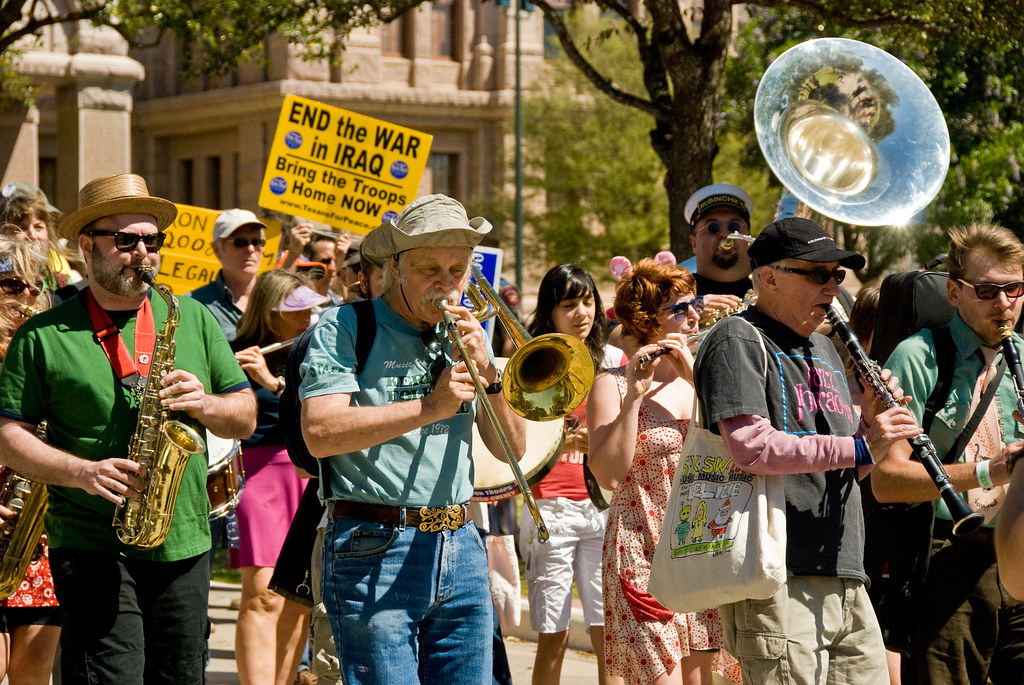
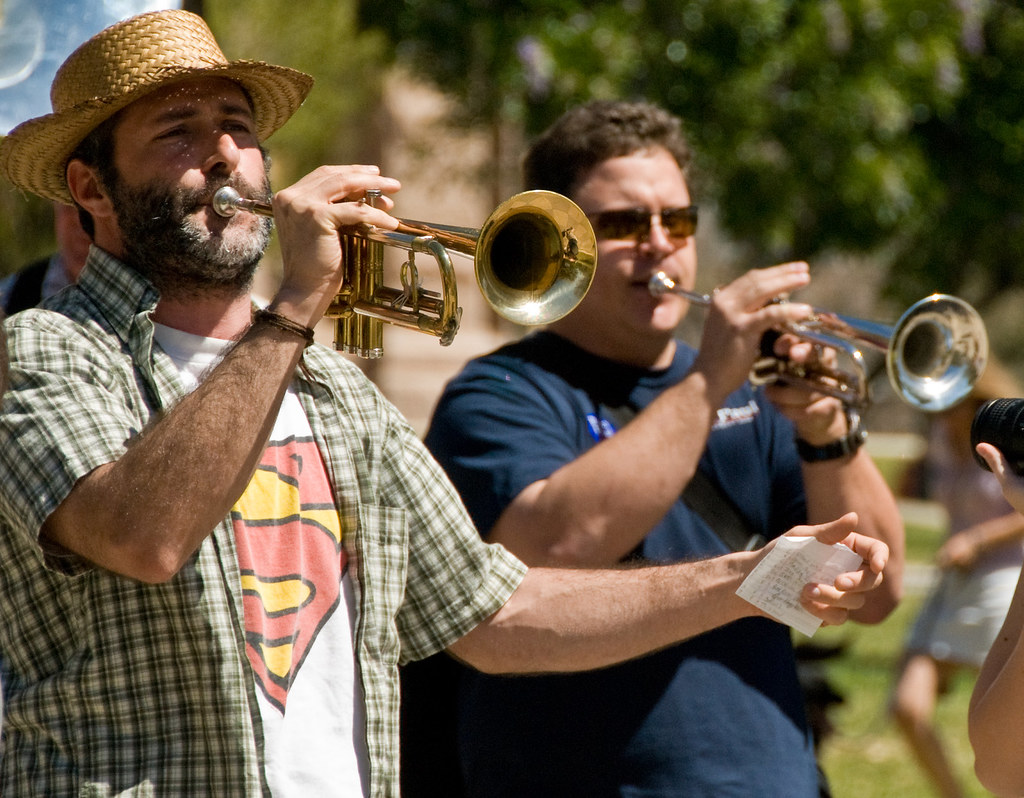
Yesterday's springtime (well, technically, late winter) peace march in Austin was almost a duplicate of last year's, and the year before, and the year before that, with many of the same faces, immeasurably more geriatric, perhaps. The parade was billed as the Million Musicians' March For Peace, and although it came up a little short numbers-wise, it was a loud and robust event musically, with a brass section at the front (which someone in the crowd, not me, joked had been provided by AARP) plus drums, tambourines, tin whistles, ukuleles, cowbells and supposedly a pots-and-pans rhythm section bringing up the rear in memory of Molly Ivins, though I was closer to the front and can't vouch for that. Just as last year, the mainstay tune of the brass was When the Saints Go Marching In, which gave several musicians opportunity to display some outstanding tuba and trombone virtuosity.

In the middle of the throng we had a guy in a kilt playing martial airs on the highland war pipes. I am not sure what to make of that.

Our parade went through the middle of the entertainment district, which this week is the same as South by Southwest. One of the first posts on this blog, in 2005, is an account of what seems, upon re-reading, to be this year's parade.

I also wrote a post on last year's event. If I were lazy I would simply link to the two earlier posts and be done with it.

Small differences are what I am left to write about, which leave me with a certain optimism. I didn't have the feeling that any onlookers along the route considered our actions unpatriotic, even when we passed by the Salvation Army soup kitchen. (Down and out alcoholics tend to be more sentimentally patriotic than the rest of us, I dunno why.) If Bush's war has lost its appeal to drunk people, maybe our country is on the road to recovery.

Just as in previous years, the street crowd, already festive at one in the afternoon, seemed a little unsure what the hell was going on, but whatever we were doing, they approved of it. Some guy came running out of a pub with his electric guitar, and feigned consternation at discovering it unplugged and thus useless for joining in.

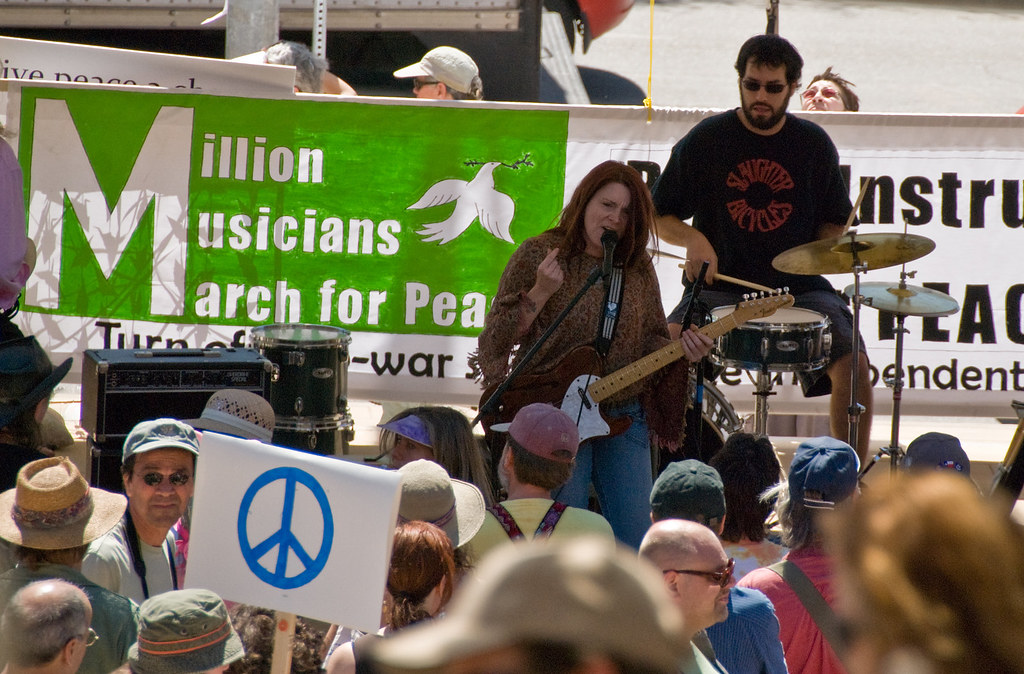
We walked a circuitous route from the capitol building to city hall, where various post-march performances were booked on the front steps. Even if there hadn't been a parade, a free venue during SxSW will always draw a crowd, so several hundred stayed for the music, shading themselves from the unseasonable heat under the awning of solar panels.

A few photos of the event follow, plus one of a runaway bride.

Click on any picture for a larger view on flickr.

-----

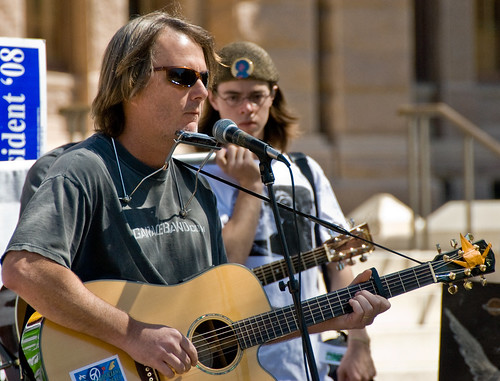
Singer songwriter in front of the capitol building, before the parade
Austin peace march 3-15-08


The march begins
Austin peace march 3-15-08


The trumpet section
Austin peace march 3-15-08


Code pink
Austin peace march 3-15-08


Stereotypical tuba player
031508DSC_4529.jpg


The bagpiper
Austin peace march 3-15-08


Afterwards, on the steps of city hall
Austin peace march 3-15-08

Now, the runaway bride was before the parade, on the capitol grounds. As the marchers gathered, I spied this young woman taking to her heels and departing. (You can see anything at our state capitol building.) If our gathering march had frightened away the wedding, the groom had apparently bolted in another direction. We will never know.
Runaway bride

Monday, December 24, 2007

What would Jesus say?

Ronald Reagan's Cadillac welfare queen seems be part of the ur-unconscious of the right-wing mind. (Would it be unfair to call it the conservative racial memory? Perhaps.) She lives there in the psychic shadows, constantly ready to be rediscovered and to emerge on demand, in the hour of conservative need.

And so it came to pass, only recently, as I understand it, that Sharon Jasper, a resident in public housing in New Orleans, complained about missing window screens, a leaking sink, and high deposit charges and utility bills in her subsidized housing. This got the attention of the New Orleans Times-Picayune, such that they sent one of their photographers to look at her apartment. Given that a leaky sink will not put any news photographer in the running for a photojournalism Pulitzer, the photographer opted for a picture of her very large TV set instead.

Now, this TV set has excited a good deal of outrage in the conservative blogs, like Ross Douthat's, for example. And I myself saw the picture. The flat screen TV appeared quite large, though the wide-angle lens used exaggerated this somewhat.

But no matter. It was definitely a big television set.

The Lee Atwater-esque encoded message here (which right wingers with instinctive wisdom never feel the need to spell out and make potentially falsifiable) is that the overburdened taxpayer has paid for this TV set, or, if not and if the money was Ms Jasper's very own, then it should have been used for several months rent for non-subsidized housing. Absent such assumptions, indeed, why else would there be the outrage?

Well, let's assume for the moment that the Atwater-Rove message is true, just for the heck of it.

The important question to ask, then, in terms of the holiday tradition being celebrated even as I write (by all except secular enemies of Christmas and maybe a few Jews and Muslims and Buddhists), is "so what?"

I suspect Ross Douthat either belongs to, or in any case and for whatever reason psychically identifies with, an income bracket that has received an inordinate Republican tax break at the expense of the rest of us, not to mention at the expense of our children and grandchildren, and as such is either himself a greater burden to his fellow men than Ms Jasper, or admires men who are. Not to put too fine a point on it, Warren Buffet, second richest man in America, is in a much lower tax bracket than his secretary, who pays twice the percentage of her income to support George Bush's war than Warren Buffet does. Mr. Buffet was honorable enough to express outrage about this, but I doubt if any conservative bloggers have. I could be wrong, of course. I haven't read Ross Douthat's archives to find out about him.

But I digress. Getting back to the TV welfare queen, and to introduce a little perspective here, this being Christmas Eve, I went to the Good Book to say what Jesus might say about the matter. Assuming that, say, adultery might be considered even worse in conservative circles than ownership of a large TV set, Jesus' words to a mob agitated by a serious transgression against a conservative moral code might be instructive and apposite. "Let he who is without sin cast the first stone."

In fact Jesus seems like the kind of guy who would get more offended about wide-screen TVs in the houses of the rich than in the houses of the poor. Specifically, "...it is easier for a camel to go through the eye of a needle than for a rich man to enter the kingdom of God." Matthew 19:24

That's a pretty hard message for a conservative to hear, but they seem to have been diligently at work all these many centuries not hearing it.

And there's this: "Give to everyone who begs from you, and do not refuse anyone who wants to borrow from you" again from Matthew. This would seem to prohibit those among the right wing who are actually Christians from being real soreheads about Ms. Jasper's subsidized housing.

In the spirit of the Season, I have to say that my overall impression is that Jesus was far more forgiving of the sinners than of those who obsess and rend their garments about the sin.

Sunday, November 18, 2007

Newspaper of record

You'd think that Maureen Dowd had at last jumped the shark with her psychotic Hillary dominatrix column in today's New York Times, but I finally realized, reading it, that the shark can no longer be jumped by an American pundit. Modo's steamy mix of unknowing self parody, psychosexual obsession, bodice-ripperesque O-take-me-Rudy fantasy as politics has finally achieved the level of the unremarkable in political journalism. I guess I hadn't been paying attention. Tom Friedman's sophomoric "Obama needs a big swinging Dick as VP" column on the same page clinches it.

One weeps for the Republic.

Saturday, November 10, 2007

Is this a great country or what?

Yesterday our born-again Manichaean president made his fourth trip to San Antonio to strut and preen before an audience of wounded and maimed soldiers at Brooke Army Medical Center. According to the San Antonio Express-News, he made a light vs dark speech where he said that "If you kill people to achieve a political objective or to advance an ideology ... you are nothing but evil." He was referring, of course, to "suiciders," not deciders.

"Bush spent almost two hours at the center chatting with wounded soldiers, including Pfc. Nicholas Clark, 26, of Seattle, around whom he wrapped his suit coat. Bush asked Clark, who lost his left leg below the knee in an ambush June 2 in Afghanistan, if he wanted to go home."

"No. I want to go back (overseas)," Clark said.

"Isn't this a great country?" Bush responded.

Wednesday, October 10, 2007

The hoverbot

The Washington Post has come out with a story about tiny flying robots which may be spying on, well, whoever. They had a photo of a robotic "fly" which was actually about the size of a wasp, resting on the tip of someone's finger. The robot wasn't shown in the air, and it was not clear that it was functional.

They also had a video which showed a flying robot "dragonfly" which did have two pairs of wings like a dragonfly, but the resemblance ended there: the robot was about the size of a great tailed grackle, and flew like a barnyard chicken that had gotten over a fence.

According to WaPo's informed sources, DARPA is also spending the taxpayers' money installing computer chips in moth pupae, hoping a bionic spy moth will emerge. They are also working with beetles, hoping to take control of living insects with inserted silicon chips.

Mention was also made of the threat of unrestricted flying robots to commercial air traffic.

The story concluded with speculation that tiny spy robots may already be airworthy and operational, mentioning various reports of odd looking dragonflies at peace demonstations.

I also have my inside sources, more credible perhaps than those of the Washington Post.

Here is the real deal, the CIA's secret spy bot. Called the hoverbot, it is about half an inch long, and contains a very, very tiny camera with an even tinier ultra telephoto zoom lens.

Hoverbot in action

Wednesday, October 03, 2007

Ken Burns's War

Having watched the 16 hours of Ken Burns's war extravaganza, I have to say I thought it sucked. There was a lot wrong with it as art, which I will get to, but there was a deep moral hole at the center of it. The artistic failure and the moral black hole are related.

Nostalgic, sentimental, slow paced like an endless thanksgiving family get-together, and deeply invested in American exceptionalism, with a self-congratulatory and mawkish backward view of any mention of the evils of the time, segregation, for example, from an implicit we-are-much-better-now-thankyou viewer-supplied perspective, plus running through it all there was a kind of subliminal and in my view deeply dishonest crypto-triumphalism as contaminating background radiation. It was a succession of Norman Rockwell Saturday Evening Post magazine-cover pictures of war on the home front alternating with the attempted-realism of non-stop newsreel explosions, weary soldiers marching, more explosions, corpses, and more corpses, and mutilated corpses, and more of them too, all with the probably unintentional effect of deadening any real realization of the human meaning of it, with a voiceover of course, explaining it all.

Mention was made of the furor that arose when the first photos were published, in Life, I think, of dead American soldiers in Pacific beach sand. Those photos had impact because no one had yet seen them. To see 16 hours straight of death and mayhem and more death and more death yet deadens the moral instincts, assuming the viewers have any left after CSI Miami and the average American action-movie genre film.

This series was in effect a vaccine against a genuine apprehension of what that war or any other war really is.

The voice-over was almost unbearable--no cliche, bromide, nor hackneyed comfort-zone voice giving sonorous meaning to it all left undeployed, and most unbearable of all was Tom Hanks reading homilies from a Minnesota small-town newspaper. I hasten to say that the homilies themselves were not unbearable in their original context. They only became so in the context of this obscene celebration of The War.

Yes, celebration. Who does Ken Burns think he is kidding?

And the celebration was profoundly dishonest, in every which way from Sunday. (Tom Hanks could really say that well, I'll bet.) First of all, the idea of taking four towns as representative of America is folly. Hispanics got angry, with good reason, because there was not a Martínez or a Gonzales from any of these places, but four towns are by definition not representative. The project of painting these towns, in black and white mostly, as "America" is flawed and dishonest from the start.

What this was, was the construction of an idyllic myth of "America" brought together by this great (and I suspect in Ken Burns's view, wonderful) crisis, The War. Rosie the Riveter rolled up her sleeves. Civilians put their shoulders to the wheel. We put our differences aside. Fresh faced boys lined up to volunteer. All underwent great sacrifice, enduring hardship, death, and destruction to further our great project, victory, which brought us all together.

What crap! What unbelievable nonsense.

Burns inadvertently makes exactly those same observations about the Japanese and the Germans. The War was a great crisis that brought everyone together, everything subordinated to the cause of victory--but, given a view from the outside, he has no trouble seeing the downside of Japanese or German nationalistic fervor.

Our guys are heroes. The Japs are fanatics. This film should really be offensive to anyone not blinded by Ken-Burns-Americanism.

Burns also comes down pretty much on the side of those who claim the use of the atomic bomb was necessary, and quotes absurd hypothetical numbers of lives-that-would-have-been-lost. Half a million American soldiers. Hypothetical numbers are great to send into rhetorical battle.

He mentions, but only in passing, and without exploring it, the fact that the Japanese were actively trying to arrange a conditional surrender when the bombs were dropped. He does not mention that the one condition they required, and which we rejected, was the retention of the Emperor as head of state. When they surrendered unconditionally, we gave them the very thing they had been holding out for in their back-channel peace proposals.

Burns, who has no concept of irony, does not talk about this.

Burns does not say a word about the fact that the chairman of the joint chiefs, Admiral Leahy, opposed dropping the bomb. He does not mention that Eisenhower opposed it. He does not mention that Admiral Nimitz opposed it. He does not mention that Admiral Halsey opposed it. He does not mention that Admiral King opposed it. He does not mention that MacArthur opposed it. Most of them opposed it on old-fashioned moral grounds. Some, who knew how close Japan was to military collapse, opposed it on pragmatic grounds.

He does not mention that Einstein opposed it. Of course not. Einstein was not from Mobile, Alabama, or Laverne, Minnesota.

The millions of people who watched the final episode of this travesty went away knowing nothing of the historical issues surrounding the use of the bomb, and now think that it was a regrettable necessity.

That's very sad.

Why did I watch it, then? The personal accounts were fascinating, and were the main reason I stuck with it all the way through. I liked all the talking heads, even the couple of them who made the war into a springboard for some well-rehearsed crackerbarrel philosophy. They spoke, as the voiceover would have said, from the heart. Their words from the heart however were drowned out by the voiceover and the the explosions and the sturm und drang, courtesy of Ken Burns. These people were deeply deceived by Mr. Burns, in my opinion, because their relatively quiet and moving testimony was perverted to his toxic ends.

I liked most of the music, but again, it was misused to further Burns's terrible project.

I never saw Burns's Civil War, and I know now that I never will.

Friday, September 21, 2007

Maureen Dowd, glossed

The first bad thing about the lifting of the TimesSelect curtain is that Tom Friedman, Maureen Dowd, and David Brooks are no longer hidden behind a protective veil, and the second is that I, a retired guy with better things to do with his time, once again feel a certain compulsion to read them. My operative relapsed-addict emotion when caught by their columns is a kind of hair-standing-on-end fascination, like when you can't turn your eyes away from some TV horrorshow like CSI Miami (which is probably really bad for you, mental-health-wise, to watch.)

Friedman and Brooks are the ones who sometimes provoke me enough to write blog responses, but I have never quite gotten a handle on MoDo. For Dowd junkies I have the pleasure of recommending a blog entry at Bats Left Throws Right, where Mr. Doghouse Riley has compiled, at who knows what psychic cost, a handy Dowd glossary that is, well, both a work of profound psychological insight and a stunningly accurate lexicographical tour de force.

The good thing is that I am no longer dependent on the kindness of strangers for Krugman.

Tuesday, September 11, 2007

Reflections on 9/11

I think September 11, 2001, was my first day back at work. Ten days earlier my wife Kay had gone into the hospital with acute myeloid leukemia. She had been extremely sick when admitted, but by the 11th she had started chemotherapy and her condition had stabilized. The oncologist told us that Kay had a 50 percent chance of being cured. I knew by then that he was stretching the truth, but I have no doubt that his motive was to make Kay feel better.

I was sitting at my computer looking up stuff in medical journals about myelogenous leukemia, when I heard someone saying that the Pentagon was on fire and that a plane had hit the World Trade Center. The White House is under attack, someone said.

Oh, I thought. That's interesting. My concerns were elsewhere. That can't be true, I thought. And I went back to reading about blood cell cancer. We had no TV in my office, but someone turned on a radio, and slowly the scope of the attacks began to dawn on me.

I don't know if you remember, but there were rumors of more planes hijacked and possible attacks elsewhere. It occurred to me that I should be with Kay. I had only scheduled myself to work half a day, so I left early and went back to the hospital. Kay was watching TV in her room when I got there.

So, like everyone, we watched the towers explode in a fireball. Again and again. We watched the towers fall, and fall, and fall again. (I have never watched those images since then, and I probably never will. I can see them in my mind's eye if I want to--and I don't much want to.)

I didn't know anyone who died on 9/11. Nor do I know anyone who knew anyone who died on 9/11. I realized watching with Kay in her hospital room, still not totally sure she would survive in the short term and very uncertain about her longer term prospects, that 9/11 was very different for a few thousand people who died, and for family and friends who were left behind, than for the rest of us. It was a national trauma, whatever that means, but a lot of people since then tried to pretend to a level of grief that is not really theirs. That is not to say that the rest of us are not sincere in being shocked or horrified or angered by what we all saw.

There were a few thousand people who suffered real grief on 9/11. The rest of us were spectators. Kay's death eight months later was more real and terrible to me than a thousand 9/11s. That is the nature of actual grief, and actual death.

What I am leading up to is that there was and is a profound bad faith at the core of the political use of 9/11, mostly by Republicans, though they are not the only culprits. It's just that they have used it more cynically than anyone else, and with incredible and heart-stopping success. They used their own pretended grief and other people's shock and horror to further, and unfortunately to accomplish, their political agenda, which turned out to be pretty goddamn vicious and monstrous in almost every way possible.

I am not a conspiracy crackpot. Even though George Bush instantly appropriated 9/11 and used it for his own purposes, I don't think he engineered it, if only because he is not that competent. Nor do I believe he passively but knowingly let it happen. His popularity was dropping, and he may have been secretly praying for a terrorist attack, but I doubt if he really knew anything about it. He is a chuckle-headed if inflexible and authoritarian superannuated frat-boy, and frat boys don't bother their pretty heads about stuff like that.

The problem is what he did afterwards. I am not talking about hiding all day in a hole in Nebraska, or was it Kansas, I forget, though that was certainly revealing behavior on his part. What I am talking about is his wrapping himself in the flag and pissing on it from the inside as he defiled the the bill of rights and set about making his office one of an elected absolute monarch. No separation of powers for this creep. He stole the country, and used 9/11 as his burglary tool.

He is still doing it, as he conflates staying the course, as he calls it, with patriotism, and sends his flunky General Petraeus to take the heat for the White House authored put-up job bogus-numbers "Petraeus report" on the alleged success of the surge.

Interestingly, George Bush and Osama bin Laden both like to commemorate 9/11. Given that it made both of them successful beyond their wildest dreams, how could we expect otherwise?

Wednesday, August 29, 2007

Another anti-war vigil in Austin

War protest
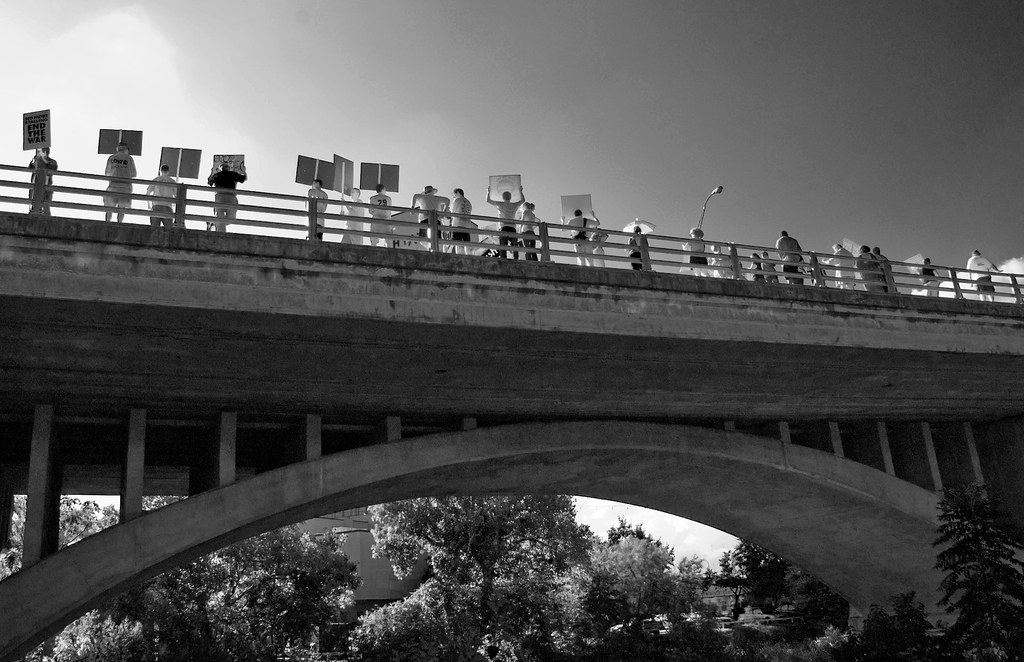
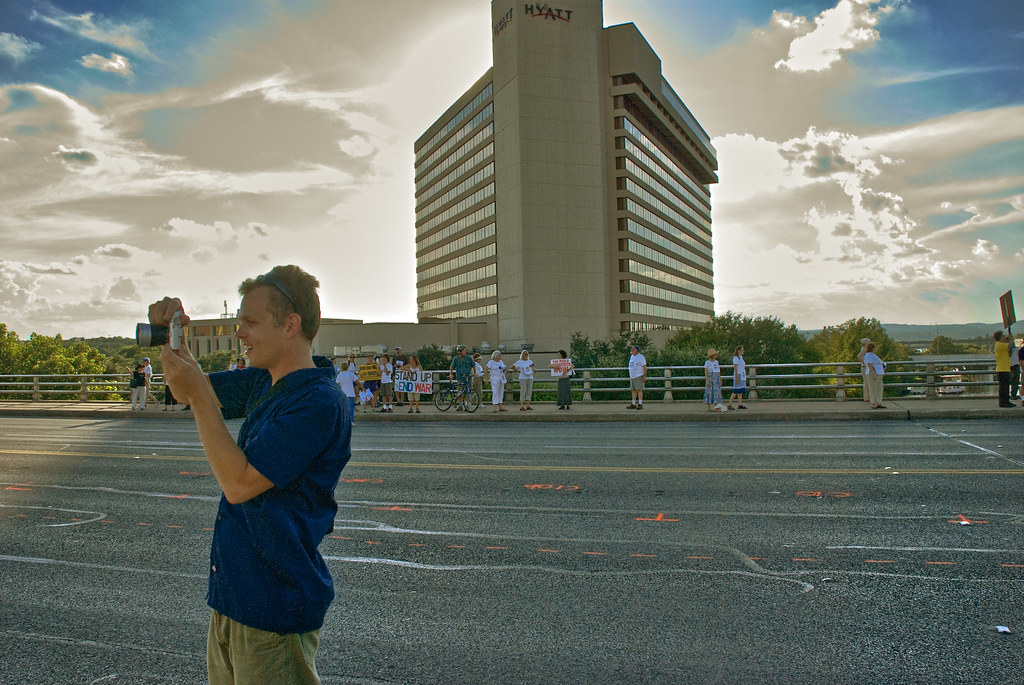
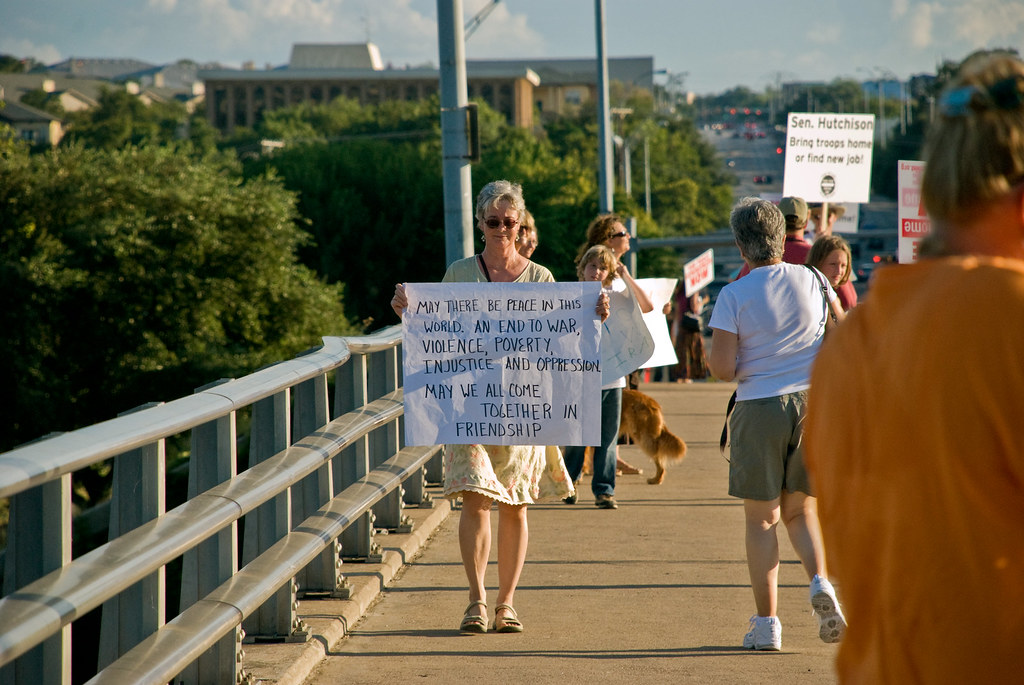
About 300 people gathered late yesterday afternoon on both sides of the Congress Avenue bridge in opposition to the Iraq War. The people driving by overwhelmingly honked in support. I didn't see any expressions of disagreement, but I don't have psychic powers to intuit the motives of the honksters who did not wave or cheer. Certainly there was no overt hostility.

All in all, it was very peaceful, and a nice afternoon to be out on the bridge, but as far as I can tell the efforts of the Austin Statesman photographer, who was busy with several cameras, went in vain--I could find nothing this morning in the Austin newspaper about the event. He certainly took more photos than I, and I took 20 or 30. But the online Statesman sometimes buries or does not run things that are in the print edition, so perhaps I missed it (I unsubscribed to the print version a year ago, for political reasons.)

Clearly though, it was not a significant news event on a day when local news included a congratulatory piece on an Austin Statesman reporter winning third prize for an outstanding food-reporting story.


War protest

War protest

War protest

Saturday, August 25, 2007

Torture once again

Here we have Megan McArdle, a conservative columnist at Atlantic.com, suggesting that those of us who oppose torture, possibly not including the columnist, should not use pragmatic arguments against torture by claiming, for example, that it does not work. She suggests that perhaps it does. Instead, she advises liberals, of whom she is clearly not one, to take the harder approach, and stand against torture on moral grounds.

McArdle, who previously wrote a blog under the pen name of Jane Galt, may perhaps be a fan of the the harder approach and the heroic pose on principle, if her taste in political literature can be admitted in evidence (she enjoys the novels of Ayn Rand, though she insists she is not, herself, an "objectivist," Rand's name for her socialist-realism stood on its head.) I find myself unfairly perhaps suspecting that if McArdle does in fact oppose torture on principle, it is because so many liberals oppose it for inferior and pragmatic reasons.

But, in any case, I agree with her that if we oppose torture, we should do so on principle, even as at the same time I have my doubts as to her bona fides as an advice-giver to liberals.

But is the legitimacy of torture something that is even a morally defensible thing to talk about? Is it a discussion we should actually have? Why do liberals find themselves invited--by right-wingers whom we are assured are earnest,philosophically-minded truth-seekers--to even talk about such a thing? Does the invitation to this intellectual soiree have another consequence, not to mention another purpose, than the unveiling of the Truth?

I am not suggesting a conspiracy, by the right. I am suggesting a fundamental flaw in the way these guys look at the world.

Let's take something similar. Suppose a right-winger proposes--and not in a Jonathan Swiftian way--that we seriously examine the case for murdering our children, and eating them, in times of hardship.

After all, 9/11 changed everything. And sometimes it works. Protein is protein.

Immediately we see the problem.

Now McArdle here in effect inserts in her by-the-way manner that really, if we _really_ oppose such cannibalism, we should do so because it is a bad thing, not because it doesn't provide calories.

Now, in the first amendment sense at least, I am not in favor of actually, legally, suppressing such a discussion. I suppose I am more in favor of a Mennonite-like shunning of people who wish to carry on that conversation with us. The only philosophical argument here, that I can see, is the case for rejecting such talk altogether, not the case for boiling and eating our children.

I suppose I would make a sort of slippery-slope argument, that the very consideration of that behavior--or for that matter, of torture--takes us closer to very bad things indeed.

At this point, someone wishing to be helpful, suggests that we should define our terms (we actually see this in comments to McArdle's blog.) What do we mean by killing and eating our children? Perhaps eating our children without killing them should be an acceptable thing to talk about. And so forth. Or to paraphrase some of the real comments, "Torture is a bad thing, agreed, but how about waterboarding?"

We see the slippery slope, here, already getting slid down.

Wednesday, August 08, 2007

Tlakaelel at Hueco Tanks

Tlakaelel at Hueco Tanks--1
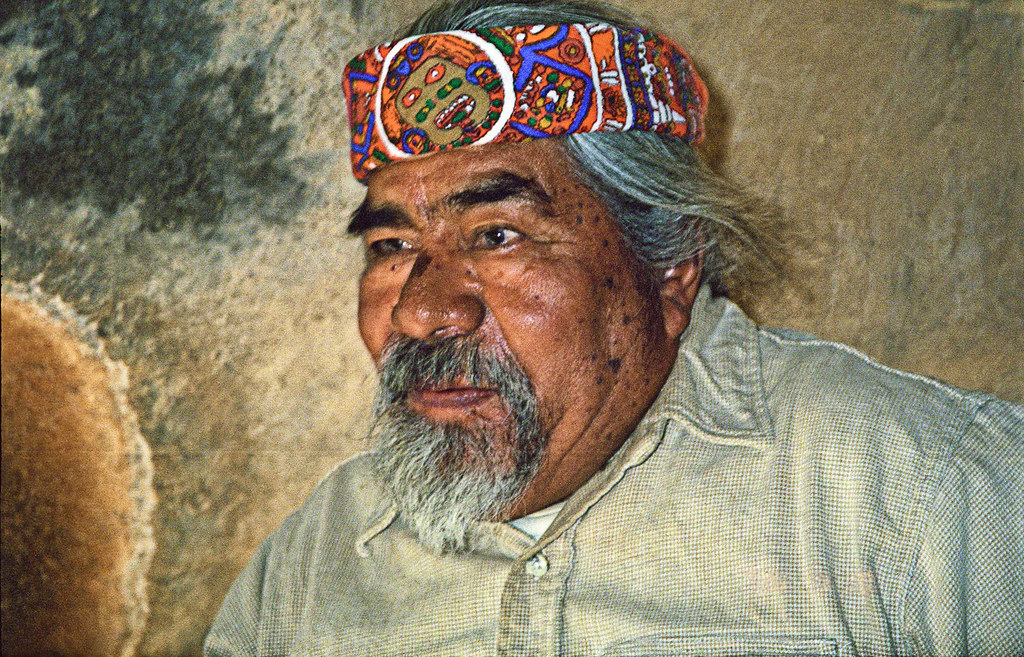
Tlakaelel is important in the Mexica movement, an indigenist religious revival movement which began in Mexico City in the 1960s. It is organized, if that is the word, into highly independent local groups called kalpullis. Partly traditional, but tending towards syncretism, this movement tapped into Chicano identity issues in the American southwest, where the kalpullis have adopted a lot of US Native American religious ceremonies and beliefs. Over the years Tlakaelel, whose real name is Francisco Jimenez, has evolved a sort of pan-Indian ideology which has a Nahuatl mythological core, but a lot of ceremonial practices gotten from North American Indians.

A few years before her death, my wife Kay Sutherland, an anthropologist whose specialties included Native American rock art and meso-American religions, had concluded that a lot of elements of southwest rock art represented a fusion of Meso-American and native pre-Puebloan concepts. Through a complex series of events, this led some kalpulli members in El Paso to seek out her assistance in getting the Texas parks system to give their kalpulli the same status to conduct religious ceremonies at Hueco Tanks State Park as some US Native American groups had.

So she spent some time interviewing Tlakaelel, who is revered as an elder by most US kalpulli groups, and she took him to important rock art sites like Hueco Tanks. She came to feel that the kalpulli understanding of these sites was certainly as valid as that of the official Native American groups. Now, the parks department wanted only groups with historical cultural continuity with Hueco Tanks. Their concept of cultural continuity was simplistic, but hey, these people are highly politicized bureaucrats, and simplistic is all they know. Kay gave it a shot, but their basic prejudice (literally) was that these people are Mexicans reinventing themselves as Indians, a viewpoint completely at odds with Kay's anthropological training, not to mention her Jungian personal views of religion.

Anyway, Kay was sympathetic to the kalpulli, and presented a perhaps overly sophisticated argument to the parks people that all religions reinvent themselves all the time, and moreover that there was in fact a greater continuity of myth between the religious symbols found at Hueco Tanks and the contemporary belief system of the kalpulli than with the contemporary belief systems of some of the allowed groups. But no dice. The kalpulli lost.

So they conduct ceremonies in the desert outside Hueco Tanks.

I think these photos were taken in 2001. Tlakaelel would have been about 80 years old here. He has a certain personal presence, as you may be able to see from the pictures.

Update: Tlakaelel died on July 26, 2012.

Tlakaelel at Hueco Tanks--2

Thursday, July 19, 2007

For your amusement...

...and speaking of Senator Hutchison, when I was sending the remarks in the previous post to the senator, I found the following caption on her web page. It was under a photo of the back of a lot of heads in an auditorium looking at a woman in the distance who may be the Senator herself behind a podium, addressing them. "07.18.07 Senator Hutchison addresses the Christians United for Isreal Washignton Summit about America's friendship with Isreal."

I am sure this will be corrected at some point, if and when a literate person reads her web page and points it out. Perhaps I will send an email to the site administrator myself.

Update: I did email the site administrator, who, without privately thanking me or even acknowledging my message, fixed the caption. Republicans. But in fairness, I guess he or she could have been fired if the Senator, who is notoriously bad tempered with underlings, found out about it.

Another open letter to my senators

I occasionally get tired of sending unread pixels to gnomes in the offices of senators Cornyn and Hutchison, and post an open letter addressed to the senators from Texas on my blog so that they might, when surfing the web, run across it and read it here. Of course I also send it the standard way, along with an invitation for the senators (or designated gnomes) to comment, either here or by return mail. They never do, unless you count a form letter.
-----------------

Dear Senator:

Having seen Michael Moore's film, I feel compelled to write to protest the awful medical system we have in this country.

The word "awful" is carefully chosen. This is the only country in the civilized world where people are _ever_ reduced to penury by medical bills. Only in America. Not only does this happen here, it happens routinely, even in cases where people have insurance they have paid for all their lives in good faith, believing it would actually be there for them when they got sick.

As you know it is quite common to have payment disallowed by insurance companies when major illness strikes. Indeed, and as you know, insurance companies employ large numbers of people whose sole _job_ is to find excuses not to pay when an insured person gets sick.

Republicans believe deeply in home ownership. As it happens, this is also the only country in the civilized world where people lose their homes because of medical bills. Medical bills are the major cause of personal bankruptcy in this country. Not only that, but because of the draconian bankruptcy laws (that YOU voted for, by the way, Senator) victims of illness now stand not only to lose their homes, but, once reduced to bankruptcy, will spend their old age (if they survive the illness, which in this country is less likely than in 36 other countries) in perpetual debt peonage to meet the requirements of their court-ordered payment plan, assuming of course they are able to hobble to Walmart to work as a greeter or stockboy.

What a brave new world you have created!

But wait--the rest of the world is not like this. I momentarily forgot. Sorry. This problem is one of the few items we can find still bearing the label "made in America." In France, and Britain, and every western European country, they spend half as much as we do on medical care, with better medical outcomes. Half as much money. Better outcomes.

And faster service.

Contrary to insurance company propaganda, in all of these countries except Canada they have a _shorter_ wait time for elective medical procedures than we do. (In Canada it's about the same as here.) And nobody at all goes bankrupt because of medical bills in Britain, France, Sweden, Denmark, Norway, Germany, the Netherlands, Switzerland, Italy, Spain, Belgium...you get the picture...or even in Canada.

Wow! How do they do that?

Well, I have a suggestion as to how. Here's my proposal. Why don't you extend the, um, "socialized" medical care you receive as senators to the rest of us? Senators and members of Congress have a very good taxpayer funded medical plan, which is comparable to what ordinary citizens have in France. I have seen the details of your plan. It's exceedingly gold-plated--for the United States, although, of course, it would be entirely normal elsewhere.

This issue is kind of personal for me, actually. A good friend of our family died a few years ago because she had no insurance and could not afford to see a doctor until she got very sick, at which time it was too late to cure the cancer that killed her--which is routinely cured if caught early. She was the sole support of two children. She worked as a waitress. Her excuse for her negligence? She had to put food on the table and come up with the rent for a roof over their heads. Obviously, in retrospect, she should have let them go hungry for a week, and perhaps even gotten herself and her children evicted. That would be the Republican way.

Maybe there's a better way, senator. The system that you and your friends have built (for the rest of us, not for yourselves), sucks. It's time to change it.

Sincerely,

Jim McCulloch

Tuesday, July 03, 2007

Dulce et decorum est

So here I am minding my own business on Flickr, where I have sequestered myself lately, looking at and enjoying other people's excellent photos, and in going through new photos on one of the groups that usually has wonderful pictures displayed, mostly of nature, I find a photo of a tattered stars and stripes against a stormy sky, with the caption "Remember the children..."

This is the day after Scooter Libby has been pardoned by The Decider in Chief, and the day before the Fourth of July, so it briefly occurs to me that politics will rear its ugly head for good or ill, probably ill, but hey, let's not jump to conclusions yet. Maybe it's an ironic comment on justice in America, where Scooter walks and merciless and often draconian sentences are meted out to the lower orders, who of course have no friends in the White House.

So with a deep sigh, I read the long entry that followed the ellipsis, which quickly fulfilled my intuition that we cannot escape right-wing political hectoring, in this case dipped in syrup, even when we are innocently looking at online photo galleries. "Some of us have highs, others lows, but really, what have we done for those who have lows unavoidable? Those away, serving, what have we done for them, for their families, for their children."

What indeed? So far, it looks like we have posted a photo an American flag. This person, who btw likes to upload photos of monster trucks crushing natural beauty under enormous tires, goes on:

"what are we doing on Independance Day to remind those children of military parents that the sacrifice they give is also as worthy of the ones their military parents give. Remember those kids who dads havent seen them graduate, havent seen the prom dress, didnt get to walk them down the aisle, havent had the first dance, missed a baptism, werent there for a birth, a first step, a first word, a first smile.

Remember those in the Services who didn't volunteer when there parents did....remember the children. "

Well, in answering the question, which our flag waver does not actually do, other than proposing remembrance and a sort of involuntary enlistment for them, I suppose that since those children already have the folded-up flag the government gave them, they have no need of flag photos, nor of reminders that dulce et decorum est pro patria mori, nor saccharin pieties and sappy bromides.

What was this guy thinking?

You know, there's not a lot you can say to someone whose father or mother has been killed in Iraq, whether that father or mother was an American soldier or one of the 600,000+ Iraqi civilians killed so far. "I'm sorry," (if sincere) is certainly appropriate. I don't know what else you can say.

But now that I think about it, I suppose that monetary reparations would be a good thing--even though obviously morally and psychologically insufficient--in that a chunk of money would at least be a practical help to survivors. The sums could conceivably be quite ample, if taken out of the profits of Halliburton and Blackwater and all the other mercenary corporate profiteers swollen like parasites with the rewards of war.

And maybe some of the superpatriots could sell of a few of their monster trucks and all-terrain vehicles and donate the proceeds to the children of the war dead. Anything helps.

Monday, June 25, 2007

Where have I gone?

I have mostly been ignoring the impulse that leads to the leaden and pedestrian (if sincere) prose you see in the movie review below, or to incendiary political rants, and taken me and my camera out in the world to take pictures of it, at the moment mostly photos of the natural world, though that may change. And I post them on Flickr, if anyone is interested in seeing lots of dragonflies and butterflies.

Regardless of the quality of the results, I seem to enjoy this hobby a lot more than writing blog entries, hence I put up a lot more pictures on Flickr--more or less daily, depending on the weather--than posts on the blog. I do try, at least occasionally, to put a little bit of explanatory (or exculpatory) writing under the photos, though, lest anything think I have slipped entirely under the spell of the visual.

So, even though the blog is still in business, please don't stay tuned here on a daily basis. But if you check back every couple of weeks, you might find something new.