Showing posts with label "Obsolete travel notes". Show all posts

Thursday, August 24, 2006

Brief impressions of Caye Caulker

Down at the swing bridge in Belize City, the water taxi to the cayes was a ramshackle but businesslike covered speedboat holding about 40 passengers on hard benches, the boat powered by three big 200 horsepower Yamaha outboard motors. Everyone filed aboard from the crowded and chaotic boat terminal, 2/3 of the passengers not-yet sunburned budget tourists with lumpy and already-grimy backpacks with protruding one-liter water bottles with suck-spouts on the theory that you can't trust the water here, and 1/3 island residents bringing large household items like refrigerators still in the boxes. Non-budget tourists fly to the islands.

But it's not like the old days. This boat was covered (though the windows were broken) and unlike in the old days the boat was not loaded to the gunwales with cargo and passengers, and some life vests were visible under the benches. I made the mistake of sitting on the middle bench, which had no backrest. At the end of about an hour of travel I would regret this choice. We were knee to knee with the passengers seated on the bench lining the bulkhead. Those opposite me were college-age girls from Australia.

The big engines rumbled to life and we moved away from the boat terminal and picked up speed down Haulover Creek. By the time we passed the last "no wake" sign in the harbor our heavy boat was moving along fast at full throttle, pulling a wake behind it that would rock an aircraft carrier.

One of the Australian girls was quietly vomiting into a plastic bag. Her nausea was something she came on the boat with, not seasickness--the ride was bumpy but the boat was not swaying in the way that sets off inner-ear alarm signals.

Being Australian, the puking girl neither sought sympathy, nor received any from her friends.

I meditated on the roar of the engines for an hour--conversation was impossible, though shouted remarks could be exchanged. After an hour we were passing the south end of Caye Caulker, formerly mangroves, which had a few mango-flesh colored McMansions that had sprouted since the last time I was here, when was it? gee, almost ten years ago. Wow, time moves like a fast motorboat.

At the front dock, we were greeted by a hustler who touted improbably low room prices (remember, we were water-taxi tourists, not plane tourists, so "cheap" was a taken-for-granted selling point) if we piled into his golf-cart taxi to be taken to Hotel X (whose actual name I have now forgotten). But we had a place in mind a hundred yards from the dock, so we needed no transportation. It turns out, though, that the improbably low-price rooms would all have been, um, filled, and by then you would have already paid off the taxi. We verified the actual prices at Hotel X later.

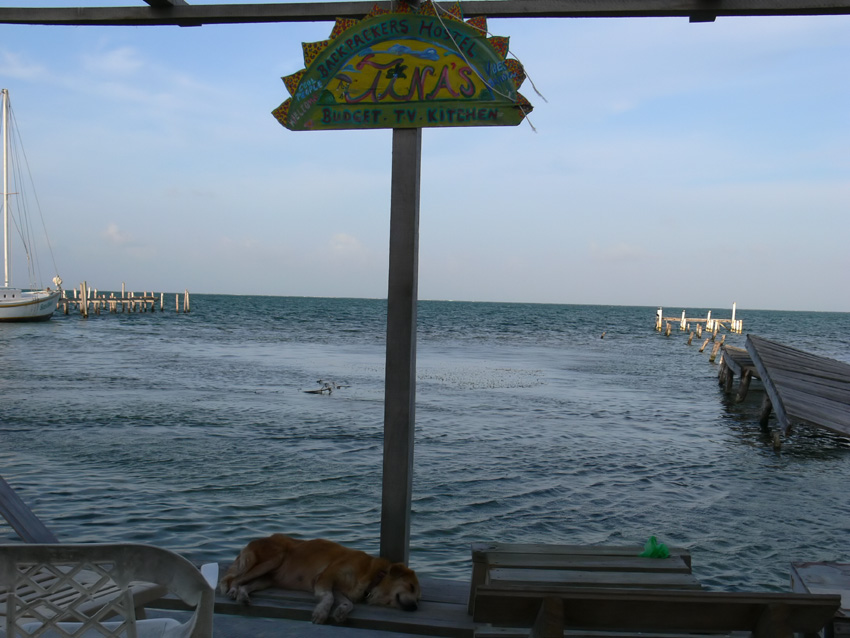
Tina's Backpacker's Hostel was colorful (see photo below) and cheap, and pretty bare-bones. The rooms were small and dim, but they were for sleeping, right? Communal bathroom and showers. Tina's has a kitchen and a fridge, and if you had a lock you could stow your valuables in wooden drawers that had insubstantial hasps screwed into them. The great thing about Tina's is the outdoor part, the porch and yard, with a couple of big tables in the shade (mostly) and several hammocks and a porch swing, all shaded by palms and overarching tree-size sea-grapes. The dock in front of Tina's has fallen into the sea, but there is a surviving covered pavilion over the water that requires a short leap to get onto, which has several broken chairs and a lovely view.

Caye Caulker has not yet been "ruined," as we nostalgiacs say, but I can see it is on the way. By all reports Ambergris Caye has not only been ruined, but is a truly awful experience, combining first-world prices and traffic, with colorless remnants of third-world inconvenience and discomfort, plus mangrove-destroying accommodations for the mega-rich-and-decadent on the outskirts of San Pedro Town and on up the island. We had been advised to avoid it and we did.

Caye Cualker has essentially no cars. Well, there is a fire truck and a police pick-up truck, but that is all I saw while we were there. Golf carts and bicycles can be rented, and are in widespread use. You can walk from one end of the village to the other on the unpaved, pale-sand streets in 15 minutes if you walk fast. If you walk south from the village you get to the realm of the McMansions and some of the pricier places to stay.

The barrier reef, second longest in the world, is the main attraction. And the island ambience.

It's still "relaxed" as everyone says, and indeed I saw and smelled a good deal of marijuana being smoked. Takes you back.

The old island fishing economy is mostly gone, I think. No doubt there is still commercial fishing, but tourism is now how most islanders make their living. That's probably for the best--they are certainly more prosperous now. I'd say there is a widespread consciousness by islanders that the health of the reef, and ecological responsibility in general, is important for their livelihood now and in the future. On the other hand property owners stand to make a lot of money clearing off mangroves to build new houses. Clearly, some have succumbed to this lure.

Many of the beautiful locally built wooden sailboats of the old fishing fleet are now gone, and the rest are now used to take snorklers out to the reef. Those sailboats, which all had a deck and a cabin and several "dories" (i.e., small dugout canoes) stacked on deck or sometimes towed behind for the crew to sleep in, were common the first time I visited the island, and I was sad to see that they are increasingly replaced by big motor boats. The fishing sailboats had a live well in the bottom of the boat which admitted sea water for keeping the catch alive on a multi-day fishing trip. The fast motorboats can ice the catch down and get back in a few minutes.

The island is divided in two by "the split," a channel which may or may not have been created by a hurricane. In any case, the split, which is free of sea grass, is the place to swim and, if you wish, sit at an open-air bar and watch the swimmers while drinking rum or Belikan, the national beer. Sea-grass between the island and the reef, which is important for ecological health of the reef and fishery, keeps the rest of the island from being very good for swimming from the shore. The split has a ruined pier to sit on while you are not in the water. The water, of course, is clear and beautiful.

It was the rainy season, which reduces the number of tourists, at least American tourists. Lots of French and Germans. Very unhealthy and severe tans, that shade of reddish brown that hurts just to look at, were much in evidence.

We spent some time with Eve's uncle Simeon Young, who is Belizean and who operates a dive shop. His family in the old days were all boatbuilders and fishermen. He was adopted as a small child by Eve's grandmother Lois some time after she married a Belizean fisherman back in the 1970s. Simeon is a few years older than Eve. His business seems to be prospering. He took Hunter out on a half-day dive trip.

On this trip I habitually awoke about sunrise, and on a Sunday morning at dawn I was walking down the sandy streets where a few island people were out sweeping the sand in front of their houses or businesses--an old fashioned practice I remembered from past visits. As I walked past the yellow police station with closed louvered windows I heard a man's loud screams coming from the upper floor of the station.

A scowling arms-crossed policeman with dark sunglasses stood in the shadows in front of the station in a don't-ask-about-this stance. I walked on, as did the islanders passing by, hurrying up a little and not speaking to each other, uncharacteristic for islanders. In 2003 a police constable was suspended for fatally shooting a man in the back of the head in this same police station. The constable claimed self defense. I have not been able to find out the disposition of that case, but it was clear from islander response this morning's unpleasantness that it would not be a good idea to stop and inquire of Sunglasses about the screams. Nothing to see. Move along.

But by and large visitors and islanders alike, while we were there, seemed to be enjoying life. Most of the islander friendliness seemed to me to be genuine and not part of a hustle. I liked being there. The food was occasionally good, and was never bad, and usually cheap. Our stay in Caye Caulker was a couple of days of relaxing, hanging out, reading in shaded hammocks in Tina's yard, and going out to the reef. And in my case, taking photos of frigate birds and boys playing in dugout canoes.

A sign on front street says "Go Slow." Everybody did.

A few photos follow. (More photos, including a lot of other parts of Belize, plus family stuff, can be seen at my Flickr page, in more or less random order, with varying amounts of explanatory material.)

The front porch of Tina's guesthouse


The view from Tina's pavilion at water's edge

This is a traditional fishing boat, with a non-traditional cargo and painted non-traditional colors. Striped, unpatched sails are also an innovation.


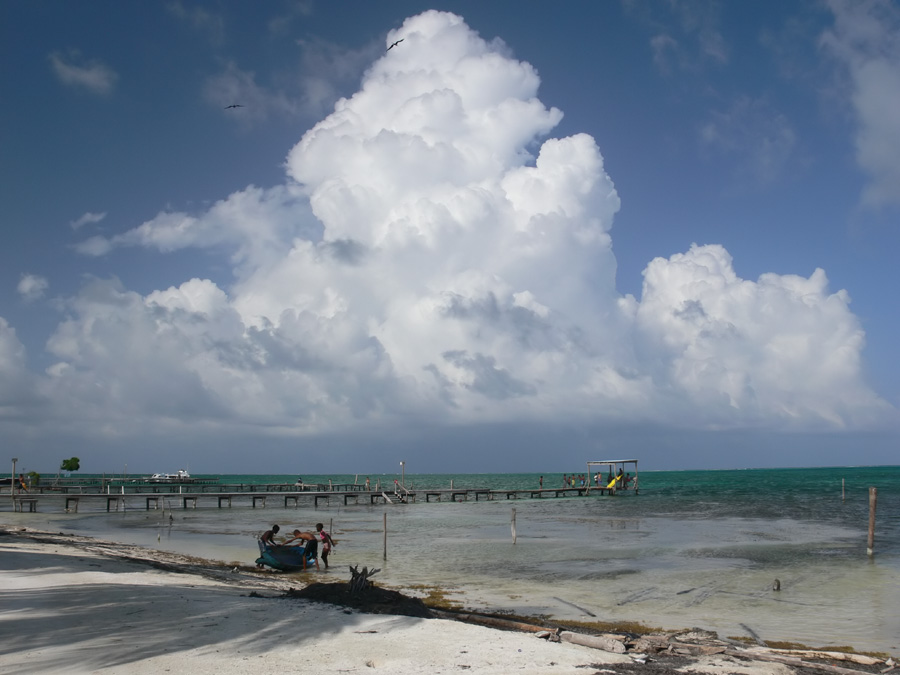
A view of kids playing in a dory on the beach.

Click on any photo to enlarge.

I'll try to put up some remarks about other places in Belize soon.

Thursday, October 13, 2005

More reasons why New Mexico is a great place to visit

Miscellaneous travel notes, obsolete, as usual--this was several years ago.

The ranger woman recommended the Willow Creek area as better than Pueblo Park. Said Pueblo Park was better in the winter. "Right now it's hot." It was also dry. I think we got a permit at the ranger station for our camp stove, which ran on propane. There was a fire ban. No open fires, and no gasoline stoves either. But propane, for some reason, was OK.

The drive from the highway to Mogollon was steep, with switchbacks. Mogollon was a little mining town, abandoned, now partially filled with retirees and with the beginnings of an art colony. Beyond Mogollon, the road was gravel and the switchbacks very steep the first half of the way, then a little better after that. The whole drive took about 2 hours. Willow Creek was right beyond a partially regrown clear-cut area.
The creek was a clear, cold stream with a mossy bottom. Our tent site had 4 tall trees, a spruce and Douglas fir on each side of the tent.

A weather-beaten man in an old, battered Toyota pick-up loaded heavily with camping gear, or more likely, his worldly goods, drove by slowly. The guy waved, went to the end, came back, stopped, with his motor still running. He got out, a little guy with a cowboy hat and no shirt, mumbled something about how it was too hot, and washed his face, after taking off his hat, by totally immersing his bald head in the stream by our tent. That taken care of, he introduced himself as Pancho, his dog as Lefty. He shook hands with me, Kay, and Eve, with formality and deliberation. "Where I come from, we always shake hands" he said.

Kay asked if his gray and black dog Lefty was a bluetick hound. This amused him. He was drunk. "No, ma'am. It cer-tain-ly is not." He said that it was some kind of Australian breed. "Herding dog. That dog's been working hard. Me and that dog." Pancho had rough, small hands, abraded with cuts and gouges. "What do you think of these hands? (long pause) I got these hands WORKIN."

He was a very slow talking drunk, and tended to lose the train of his thoughts. He told us the roundup was done and that he had come up to take a month off. He began to tell us that he could live in the woods if he chose to, because he he was very expert in matters of camping, hunting, and fishing.

"Best place to fish is the beaver ponds."

Kay asked where they were, and how many ponds there were. This stumped him for a while, because answering two questions at once taxed his powers. He counted internally, silently. 4, 5. "Five ponds, ma'am. Up there, up the creek." He offered to show us. He said we could see the beavers "of an evenin."

We talked about the fire ban. He first said he was going to eat cold camp food, but then confided ("I'll say you're lyin' if you tell a soul") that he intended to build an illegal fire. "If you know how, like me, you won't start no forest fire."

He rolled a cigarette. Very slow process. Painful. "Law says I can't smoke this cigarette." (lights it, with his lighter, which works properly--he seems surprised--"I love it when things work" he says) "But I know how to smoke so I don't start no fire. No sir. That ranger lady in the cabin up there is a very fine lady. What she don't know won't hurt her." He intended to build a very small fire very early in the morning. He offered to lend us a skillet, if we needed one.

He told us he had been a special forces captain in Vietnam, and had been captured by the Viet Cong, who had starved him, forcing him to eat coffee grounds and eggshells. "I don't much like to speak of that," his eyes moistening with emotion.

He said that on Memorial Day he was with some "old guys, that was in World War two, and I shook their hands and said how much I appreciated what they done for this country." Long pause. "You know, though, what hurt my feelings?" Long pause. "They didn't say they appreciated what WE done. Us Vietnam veterans.. That hurt my feelins. They think they're special, cuz it was a world war. Whereas ours was just a conflict. That hurt me." He went on to mention some misfortune of bureaucratic record keeping such that he couldn't even prove he had been in Viet Nam.
He composed himself, saying "...but that's OK"

I wanted to get a photo of the beavers so he took us to the beaver ponds, which were about a hundred yards away. He stopped his pick-up in the middle of the creek. But no beavers were visible. While we were sitting in the creek he said that he was really fond of "cowboy poetry." "I just dabble in it. But I keep a daily. You know what a daily is?" We didn't, exactly. It was where he wrote down things he liked. He illustrated by reciting the whole of the Marty Robbins version of the Strawberry Roan from memory. Kay asked him if he would sing it.

"No, ma'am--I'm not Marty Robbins."

Later on, about dark, I walked up to where his pick-up was parked to see if he wanted to come have some coffee we had made, but he was asleep in the cab of his truck with his boots still on, the door open, his dog on the floor beside him.

Tuesday, July 26, 2005

Mountains and rivers sutra, again

For a while now I have been occupied trying to salvage old photos, mostly color slides, faded, that have been stored in bad conditions, and some of which, regrettably, are water-damaged. I have far more than I can scan, but I have been scanning the ones I like, and putting the rest in archival storage sheets. Slow going, and it has interfered with my blogging, I suppose.

The batch of photos I just went through were from New Mexico. I have pictures of myself with a bunch of archeologists. I forget now why we were camping with them up in the wilderness above Three Rivers, where there is a big prehistoric rock-art site.

But I remember that it was a summer night and we were anticipating an eclipse of the moon. We had our tents where a bright cold creek smashes out of the high pine forests and slows as if surprised at the sudden change, on its way down into the desert sand where it disappears a few miles from a crazed and heat cracked lava flow which lies at the very bottom of the desert floor. Beneath an alligator juniper I watched Venus, which seemed big as a pearl, and Saturn light up above the gunflint cirrus sunset, and I nibbled on trailmix while the archaeologists got drunk and told extravagant stories full of baroque detail about heroic excavations of the past and the fearful hardships of the present one.

Bats laced the evening air with squeaks.

So I told the story of an earlier night in a tent, in Big Bend in Texas, when I was camped with my girlfriend near the Rio Grande at Big Bend National Park on the hot June night after Robert Kennedy was killed, when we had been forced to sleep inside a tent because of the disturbing feeding habits of the large white bats eating Junebugs. The bats would flop fearlessly down on the ground right beside you to nab their prey, and I had visions of being awakened by a Junebug crawling over me and a bat choosing to flutter down and eat it right at that moment. So, we crawled inside the tent and we didn't get much sleep inside the sweltering tent that assassination night with the occasional thump and scuffle of a bat against the tent fabric. In the morning we found Junebug legs in little double threes clinging to the netting of the windows, signs of an alien world traced like a code on the most intimate and human of habitations, our tent.

The archeologists scoffed, that's nothing, they said, and began telling stories of more painful and/or horrific bug or bat adventures.

During that eclipse night in the White Mountains, later on, the moon got darkened from the lower left, and finally at about 11 o'clock it was entirely a luminous orange-brown, Halloween colored, and all the stars got brighter. It presented the "illusion" (as compared with the flat diskness of the regular full moon) of being really spherical, and it hung in the claws of Scorpio like a kumquat. I went to bed, lay in my sleeping bag and watched the moon and listened to the coyotes sliver the night with their thin yelps, yip yip yee-ip, and I imagined them silhouetted on rocky outcrops slicing out their cries. Crying thoughts of sheepkilling and bone-gnawing.

The next morning I walked up the creek. I had read that Indians never slept by a mountain creek, because of the noise, like traffic; they liked to hear what was going on. The creek noise drowns everything else out. I took a bath high up in the Douglas fir and ponderosa forest to get the desert dust of the day before off, and the snowmelt water hurt and made you numb almost instantly. I bathed in it about 15 seconds, making gutteral shouting noises. Then I kept walking up to the tree line. Up at the top of this space I looked out over the distant bolson, where the stream disappeared, down below at the bottom of the empty sky. Quite a view, but the dip in the creek had taken my breath away already, and you can only have your breath taken away once per walk.

Jim by creek

Thursday, June 30, 2005

Mountains and rivers sutra

It's getting hot here in Austin, and every once in a while I find myself longing for the mountains. The southern Rockies. Kay and I used to spend a lot of time in the mountains in New Mexico and Colorado.

Somewhere in the Black Range, in the northeastern part of the Gila wilderness, is the most beautiful spot I have ever been privileged to see, or perhaps ever will see. I will probably never find it again--not that I will look for it, I am not that foolish--a meadow covered with flowers up in the mountains, with hummingbirds all around, big Ponderosa pines upslope a little, and a view for miles the other way. I know roughly where it is, but I'd have to get there at exactly the right moment again, if I were ever to try to go back, which, as I said, I won't. It's better to find new places, and remember old ones the way they were.

I have no notes to reinforce, or falsify, that memory, but I just found some from 9 years ago in the Gila. Kay and Eve and I were spending the night at the Lower Scorpion campground near the touristy cliff dwellings. We were going to walk up to the cliff dwellings in the morning.

The campground was pretty empty because of fire danger. We shared the place with a big fella with a Minnesota Swede accent, who had a very modulated but resonant voice explaining with Scandinavian matter-of-factness the putting up of tents and other mysteries to his little daughter, who was maybe 4 or 5. Later he sang the doe, a deer, a female deer, re, etc. song to his daughter in a very good show-business voice. He sounded so much like Garrison Keiler I had to look twice to be sure it wasn't. It wasn't. He knew all the words, and the words to several other songs, children's songs, which he sang to the campground. His wife was small and quiet. They were enjoying their stay.

Two women who had been hiking all day came back, tired, heaving enormous backpacks onto their picnic table. One of them, after searching unsuccessfully for something in the back of their red pickup camper, leaned on the truck and put her head on her hands on the top of the tailgate. Cried.

A woman with red hair driving a big RV came in and asked in a distraught way if there was a phone at the ranger station. She had a German guy with her, who spoke no voluntary English. They did not smile and each got out of the car and went to a table and wrote in a journal, only occasionally speaking to each other.

Little moment of sharing the campground.

Towhees rummaged under the picnic tables. Stellars jays and towhees own the place. A raven flapped downriver until he found a thermal, then soared like a vulture, making a wooden croak noise like a pull-toy I had when I was a little boy, where the wheels drove a hammer that beat rapidly on the central dogshape plank soundboard of the toy when you pulled it.

Cicadas--one kind made an electric rising-falling buzz, one cycle per second. Another kind made a steady buzz/chirr that lasted about ten seconds, then trailed off.

Hollow whiff of another raven flapping close overhead, a noise like blowing across a bottle hoarsely, though more sibilant--the snick of a long knife separating the wind.

The wind in the pine needles would approach through the ponderosas, like a distant avalanche. Throaty whisper.

A fast white wingflash of a merganser, whiffling like a tumbling artillery round to a landing in the stream beyond some trees.

Eve and I walked up pretty close to 8 deer--they seemed contemptuous of our sneaking, when they finally looked up at us.

The rocks were from blackish purple (weathered, lichened) to pinkish white. Olive colored juniper. Ponderosas had red platy bark, sometimes blackish toward the bottom. In the distance, the dry leaves of the pines looked light smoky green. Oaks with black liveoak bark, striated with elongate diamond plates. They had light gray-green leaves, soft looking, not oakish looking at all.

Horehound, coyote gourd, white thistle poppy, sagey gray plant along river and road. Datura in flower near on cliffs.

Glowing cumulus in the evening.

Later.

White moth in the full moon light.

Next morning we walked up to the cliff dwellings. We were the first ones in. The gravel floors were neatly raked. The ranger came along and examined our footprints in a raked area. Asked us if we made all of them. Yes. He said he raked it because sometimes people came in after hours. "What do you do if you find tracks, examine the campers' feet?" Kay asked. He said "well, its an idea." Kay laughed, but it was not clear if he intended to be funny. He took his summer job pretty seriously.

We walked up to the hot springs on the west fork. A sign said the water contained organisms that might be harmful to your health, and not to get the water in your nose. We splashed around, probably got some up our noses.

Later I read more about the harmful organism, an amoeba that is usually fatal. Fortunately, it is very rare.

Slept cold again that night.

We went on to a more remote camping spot, but I don't have any notes for that. All I remember is seeing a giant bullfrog in a beaver pond, and realizing that the the silhouette he presented looked exactly like depictions I had seen of the God Tlaloc. A rain god.

Thursday, April 14, 2005

How to peel a coconut

Reading Basho's distilled and poetic travel entries set me to searching my computer for scraps of my own travel notes from trips over the years, hidden in badly named files. The best scrap I found, and the opposite of a Basho entry is this, from a trip to the jungle in Costa Rica, 15 years ago.

Eve raised her hand, as if she were in school, as we were about to leave, and asked Damma, our river guide in the jungle,
“Um, can I have a coconut, please?”
Damma looked about his yard and pretended to be amazed that it was littered with coconuts.
“Coconuts? Coconuts! Oh yes, we are in luck.”
He looked up at the coconut trees.
“Them coconuts must have just fell down!”
He picked one up and deftly peeled off the outer husk using his machete, first girdling the thick and fibrous husk and then prying it loose in two halves with the limber blade. Then he took the coconut in his hand and with oblique strokes with his very sharp machete chipped off pieces of the hard shell exposing the meat beneath. He turned the coconut in his hand as he worked, and in about ten unerring strokes had flaked off the entire shell and was holding a sort of melon of totally unscathed and unscratched coconut meat with the milk still inside. Then he sliced off the top making a coconut meat cup for Eve to drink the milk out of, and offered it ceremoneously to my daughter.
Eve took it and thanked Damma politely. She tasted it and made a face, “Yuck!” and handed the coconut cup to me. Damma was amused.

We took the coconut back to our room to eat. Coconuts are so abundant they are fed to the pigs and chickens. The woman who owned the seaside hotel enforced high standards of behavior for her guests, and forbade the eating of coconuts in her rooms because they were animal food, so we had to eat it on the sly.
------

The peeling of the coconut, nearly done
Peeling the coconut