Showing posts with label birds. Show all posts

Thursday, February 15, 2007

Thursday buzzard blogging

A couple of shots of Cathartes aura.

Checking me out
Buzzard-1


Flying away, since I seem to be in good health
Buzzard-2

Friday, January 19, 2007

I haven't been out much...

...because of several days of rain followed by an ice storm. It is still cold (for Austin) and muddy--not good for trekking around outdoors. But I have been keeping my bird feeder filled, and the birds come to me. This bird, a downy woodpecker, is not at the bird feeder but is busy investigating my fig tree, which, no longer encased in ice, kept the bird interested for 15 minutes, which must be a week in downy woodpecker time. I think the ice may have split the bark to reveal some food source--in any case I don't recall seeing a woodpecker in the fig tree before.

Downy woodpecker
Downy woodpecker

click for larger view

Thursday, January 04, 2007

Three views of an orange-crowned warbler

This warbler was rustling in some leaves behind my house. It seemed very busy, and let me get close enough to get some good photos. Although I couldn't tell as I was taking the pictures, it seems to have found a small gelatinous delicacy to eat.

Searching
Orange-crowned warbler 1


It finds something
Orange-crowned warbler 2


...a mid-morning snack
Orange-crowned warbler 3

Tuesday, December 26, 2006

St. Stephen's Day waxwings

Today is St. Stephen's Day, or Boxing day in the British Commonwealth. St. Stephen is both a mythological and a composite figure in Christian lore, because there were several real persons known as St. Stephen, and the some of the deeds attributed to St. Stephen could not have been performed by anyone, most notably being martyred at two different times.

Officially, he was supposed to have been killed off by a mob after the Sanhedrin condemned him for blasphmy in about 34 AD. He was thus the first Christian martyr. Because of that, he seems to have gotten mixed up in the ancient legend of Herod and the Cock, which has Herod the Great being informed that a greater king than Herod himself has been born in Bethlehem, and, like all despots when receiving bad news, Herod responds badly.

In a medieval English carol I am fond of, Stephen appears as a waiter in Herod's hall carrying in a roasted boar's head, and when he sees the star over Bethlehem, dramatically quits his job and gives the King the bad news, as follows:

He cast adown the boar's head,
And went into the halle;
"I forsake thee, king Herod,
And thy werkes alle.
"I forsake thee, king Herod,
And thine werkes alle,
There is a child in Bethlem borne,
Is better than we alle."

Herod at first mocks Stephen thinking him mad, and then says that such a thing can no more be possible than for the chicken on his plate to come to life and crow, which, of course, it immediately did.

Herod take this very ill and has Stephen taken out and stoned to death.

Another Stephen, St. Stephen of Hungary, was a pagan nobleman who murdered a rival by gouging out his eyes and pouring molten lead into his ears. After this Stephen converted to Christianity, he required of Hungarians that they too become Christians, and, evidently being being impressed by the cautionary example of the rival, the Hungarian people did so.

"St. Stephen," whoever he was, is (or has been at various times) the patron saint of bricklayers, stonemasons, headaches, horses, and is now associated with gift-giving, at least in English speaking countries.

So, since St. Stephen is also associated with the wren for reasons that are very unclear, I went out birdwatching today, and saw some more cedar waxwings. This seems to be a good year for cedar waxwings in Austin. Some years I hardly see them at all.

It was a beautiful day in Austin, by the way. No wrens, however.

Couple of waxwing photos below:

Three waxwings in a hackberry tree
Cedar Waxwings on St. Stephen's Day--photo 4

Waxwing on a broken branch
Cedar Waxwings on St. Stephen's Day--photo 5

Tuesday, December 12, 2006

Town birds at Town Lake

It was a fine, sunny day in Austin, after a spell of cold and damp weather. I went down to Town Lake to see which ducks are back, and found ruddy ducks, buffleheads, and great numbers of lesser scaups.

Having also lately taken an interest in butterfly photography, I noticed that several butterfly species are still out in good numbers, notably American snouts (not nearly as numerous as before the first freeze), buckeyes, and a large yellow Phoebis species, either agarithe or philea. But I had my 1.7x tele-extension lens on because I wanted to take pictures of birds, and this is no good for macro shots.

I thought I had better pictures of the birds than it turns out that I did. Below is the best of the scaup photos.
Lesser scaup, Austin's Town Lake


This is a female ruddy duck. More commonly they have their short, stiff tails held almost upright.
Female Ruddy Duck, Austin's Town Lake


This is one of Austin's monk parakeets. They have lived and bred in Austin for 30 years or more. They are temperate and subtropical birds from South America, and can withstand fairly cold weather. They like power poles.
Monk parakeet in its natural Austin habitat

(click for larger versions of the photos at Flickr.)

Monday, November 20, 2006

Monday photo miscellany

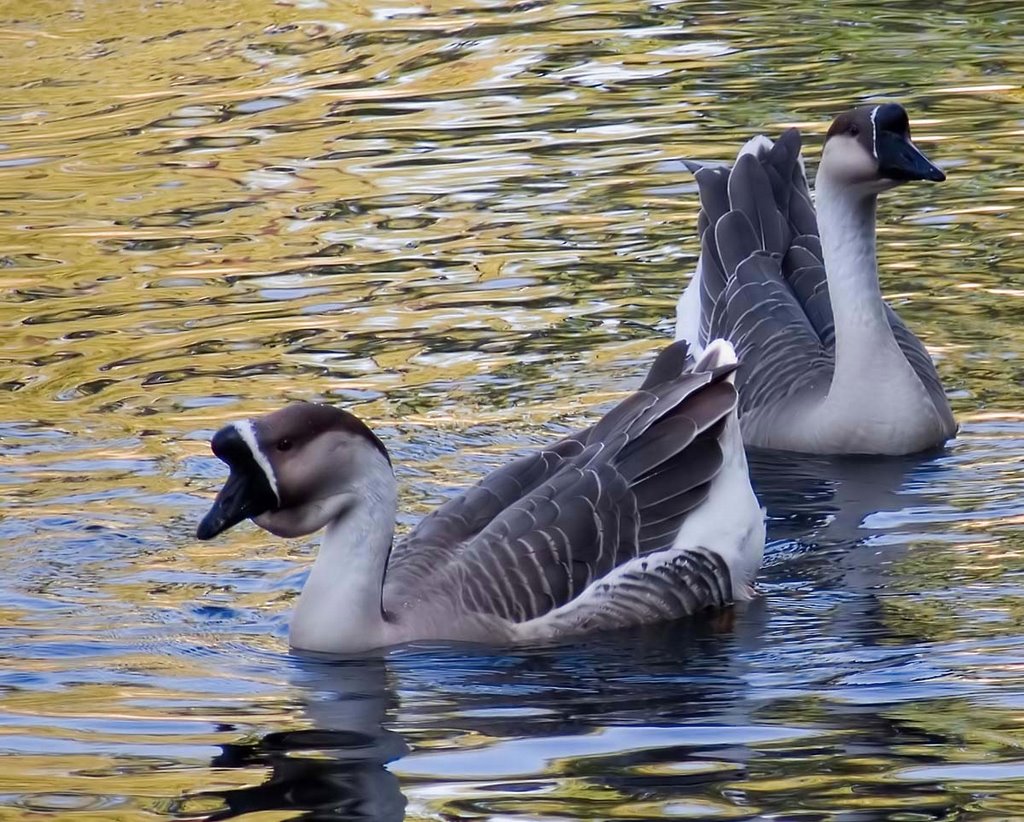
These are escaped domestic Chinese geese, Anser cygnoides, on Austin's Town Lake. Chinese geese are descended from the wild swan goose of Central Asia, which is not a swan+goose hybrid, but rather gets its name from the head, which resembles that of a swan.


We still have a few straggling flowers in Austin. We have not yet had a killing frost, but we will soon. This is some kind of small aster, blown up larger than life size.


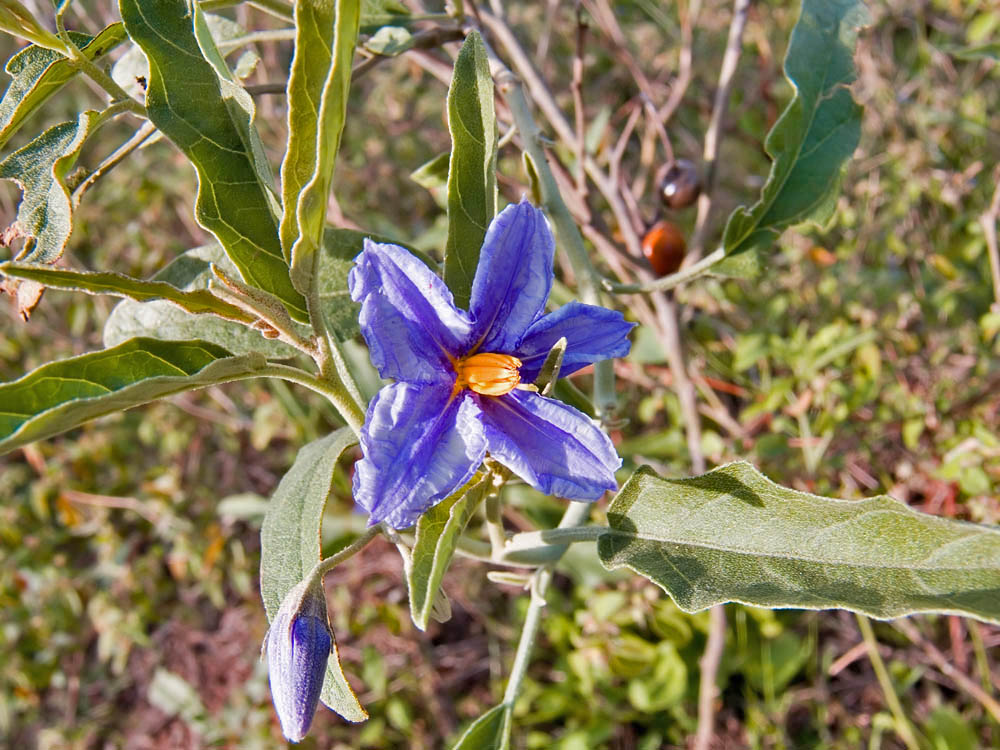
A nightshade species.


A robin near Onion Creek.


Another robin, a few feet away from the first. The robins are back in large numbers now.


(Click any photo for a larger view.)

Note: No more posts here till after Thanksgiving.

Friday, November 17, 2006

More November butterflies, and a hermit thrush

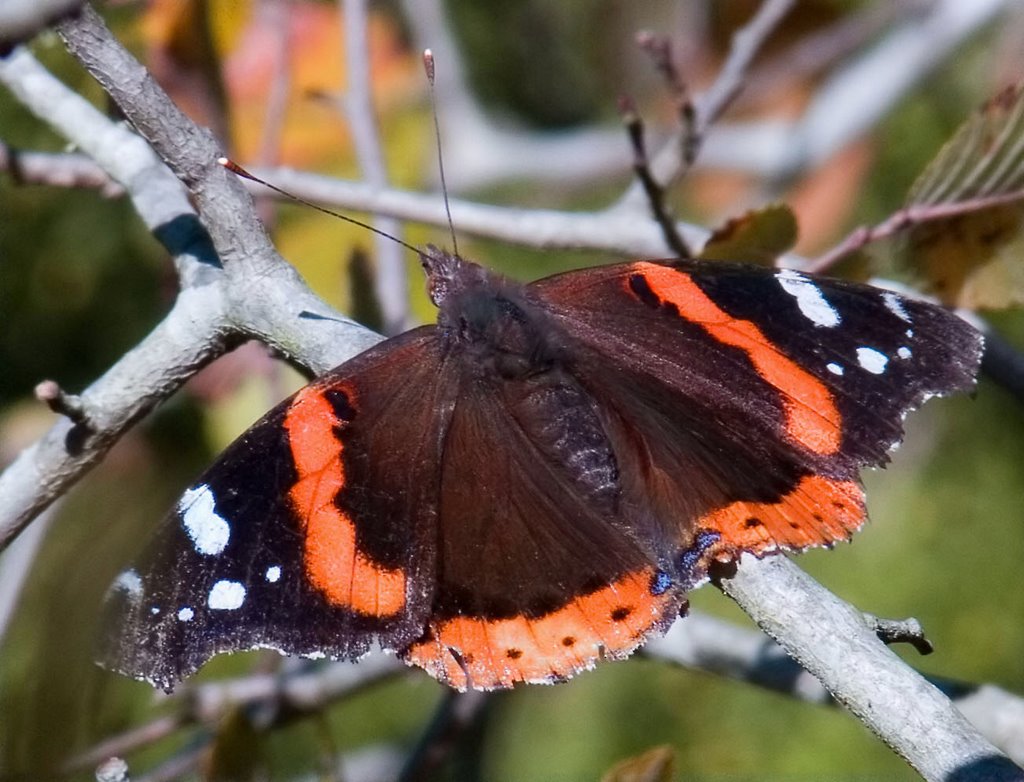
A red admiral, Vanessa atalanta, in the afternoon sun at the Onion Creek greenbelt


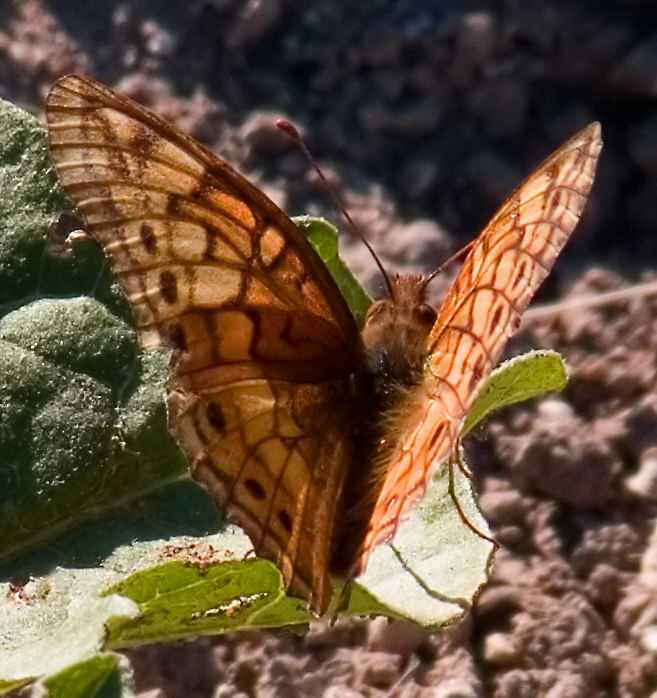
A variegated fritillary, Euptoieta claudia, also in the greenbelt


Another view of the frit


This hermit thrush was left staring warily at me, occasionally flicking its wings, after the tree full of robins I had been stealthily approaching (I should put stealthily in quotes) exploded in alarm--actually, it was three separate salvos of robins, 15 or 20 each I guess, launched about half a second apart, rocketing through half-bare November hackberry branches as I fumbled with my camera. Damn, I thought, so much for stealth. But the hermit thrush was still there, nervous, wondering what I was doing down there, but unwilling to leave.


click any photo to enlarge

Wednesday, November 15, 2006

More bug and bird photos

I have been more inclined to read than to write, lately, and I am at the moment occupied reading George Monbiot's Heat: How to stop the planet from burning. I am not yet sure whether it is a hopeful book or a depressing one--he proposes, at the beginning, that the 80% carbon emissions reduction estimated by many climate scientists to be needed to avoid catastrophic global warming is wrong, and that a 90% reduction is actually required. Then he says he thinks it can be done. Given that the less-than-10% goal of Kyoto has not been met, if for no other reason than having been effectively sabotaged by the United States, his claim that a 90% reduction can be reached has caught my interest--but I am closer to the beginning of the book than the end.

One thing he says at the outset--and I am sure he is right about it--is that sporadic individual action, however well intended, won't suffice, and that persuading governments in the developed world to take action is the key.

But more of this later, perhaps, after I finish the book. For now, here are some Tuesday pictures of Town Lake wildlife.

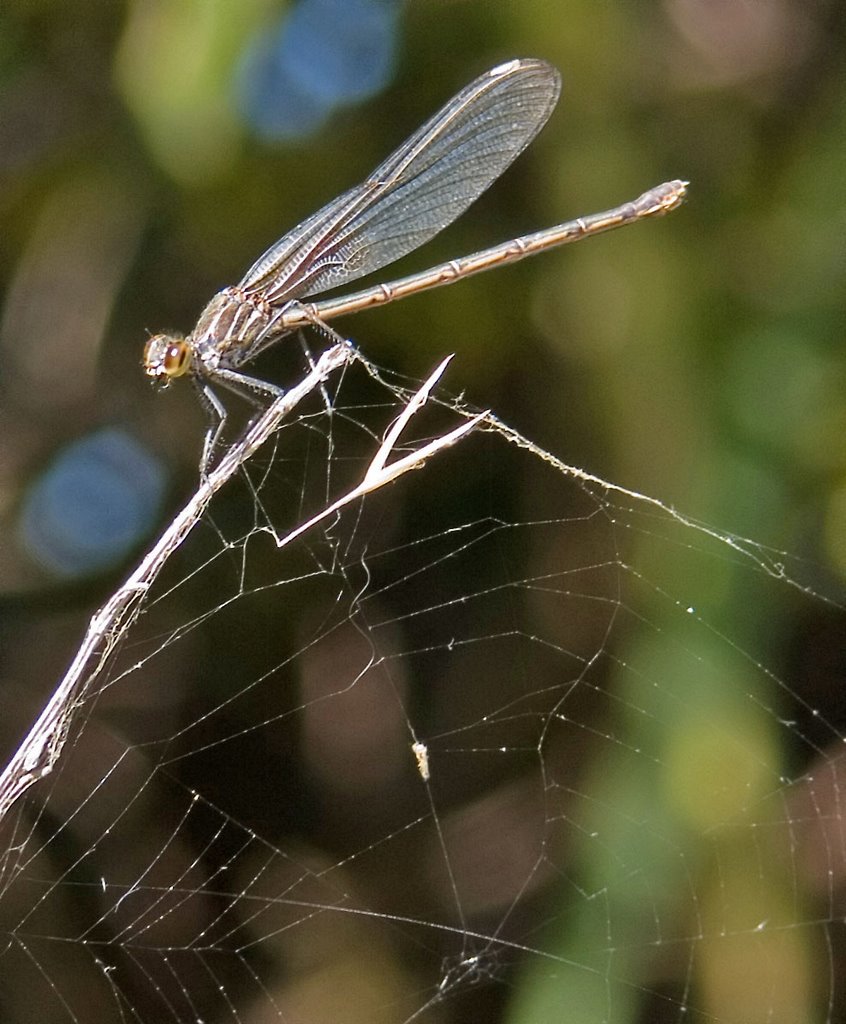
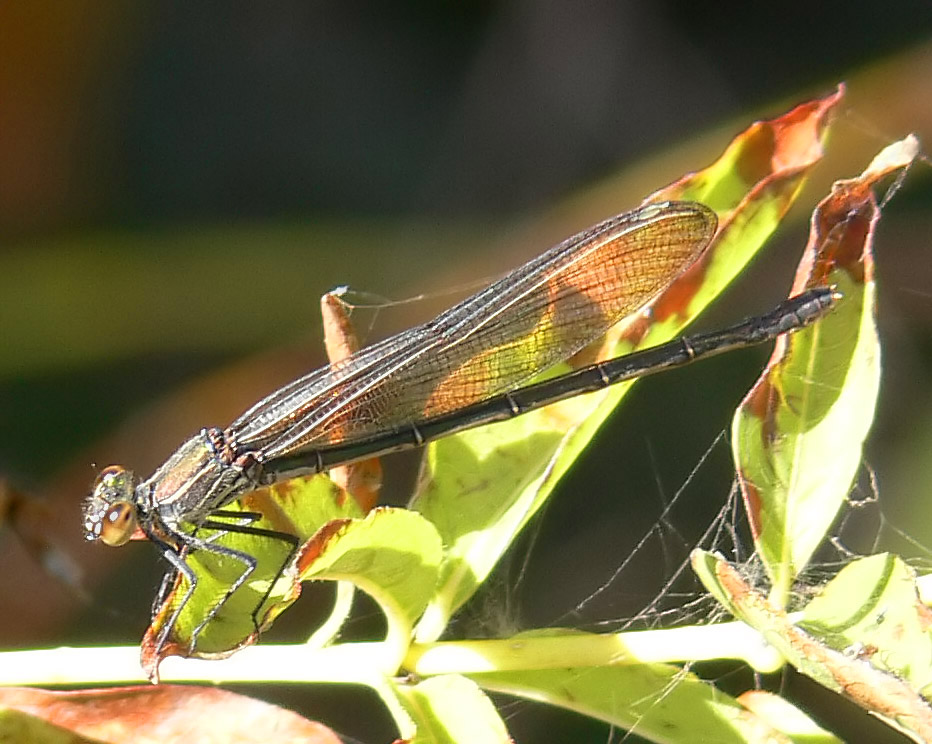
This is a female American rubyspot, Hetaerina americana


Another female rubyspot


...and a male American rubyspot


A snowy egret.


click any image to enlarge

Saturday, November 11, 2006

Saturday random juxtapositions

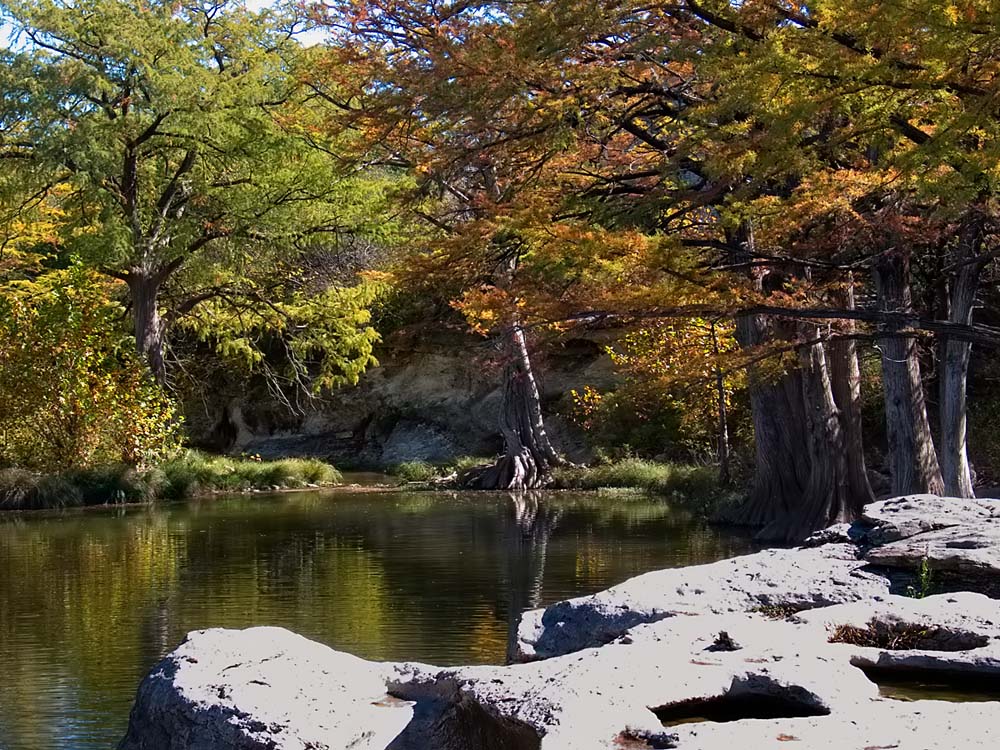
Onion Creek Baldcypress trees. This is at the upper McKinney Falls. Some years the cypress trees provide a bit of fall color.


A ruby-crowned kinglet also near Onion Creek


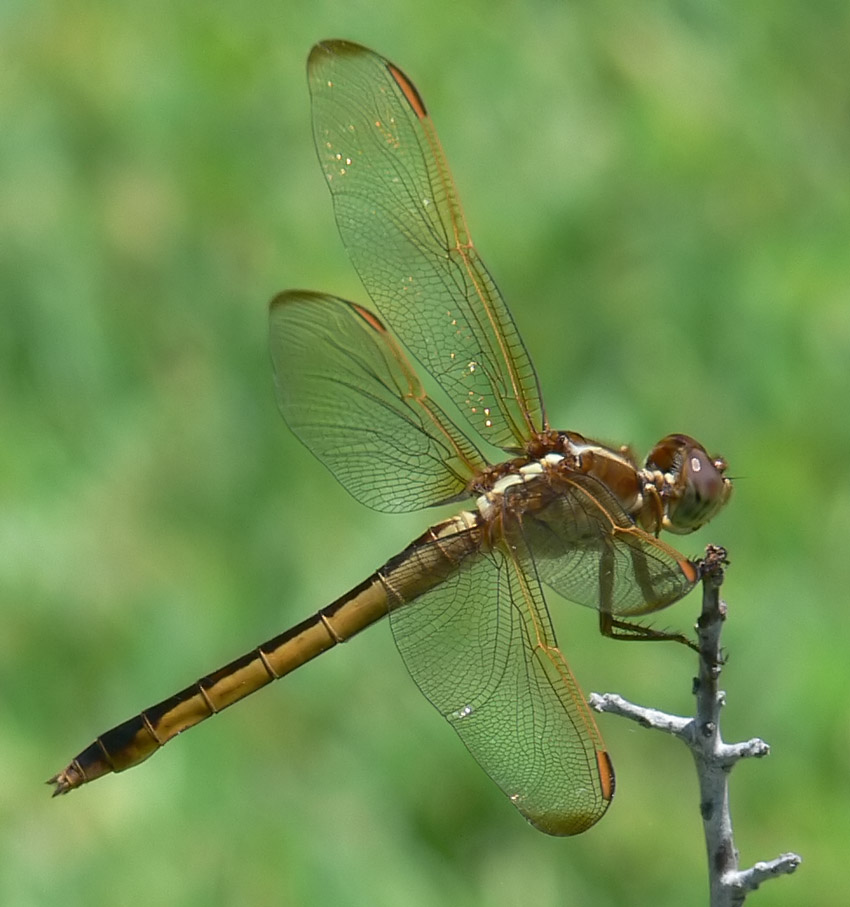
Roseate skimmer, Orthemis ferruginea. These are very handsome dragonflies. I took the photo several days ago, in Zilker Park.


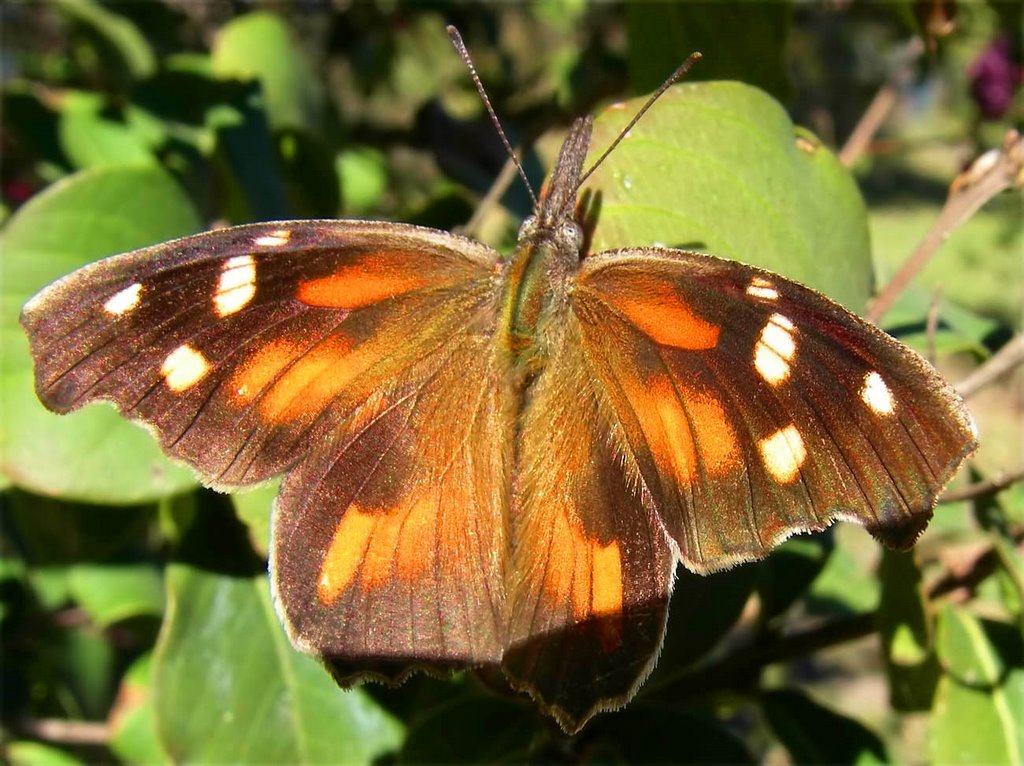
Yet another American snout butterfly, Libytheana carinenta. They are amazingly abundant around Austin this fall. No one knows why, really. This one has obligingly, and uncharacteristically, opened its wings. Generally they keep their wings folded and look like dead gray leaves.


Click any photo to enlarge

Monday, November 06, 2006

Monday at Zilker Park

Here is a miscellany of photos I took in Zilker today, first below Barton Springs, and then in Zilker Gardens.

These gadwalls and the snowy egret were sharing a rock in the middle of Barton Creek below the dam.


Another pair of gadwalls resting on a flat rock by the bank.


Fox squirrel by the creek


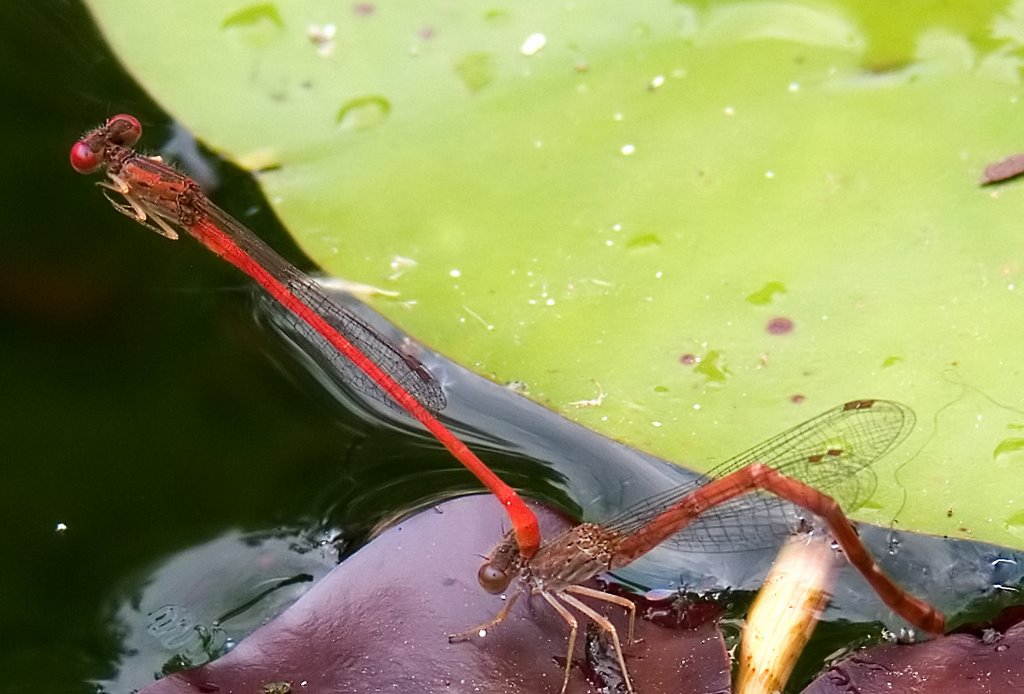
Here are two desert firetails (Telebasis salva) on a lily pad in Zilker Gardens. They have just mated, and the female is now in the process of laying eggs. The male is still attached to her head. Odonate sex, like all sex, looks strange. The male attaches behind the female's head, then the female reaches up with the end of her abdomen to fertilize her eggs at the male genitalia. Then she can lay the eggs, which is what's going on here. With some odonates, like these desert firetails, the male remains attached to the female's head while the egg-laying is going on. I am not sure why.


This is another great spreadwing, Archilestes grandis. Zilker Gardens is the only place I seem to find them.


Click any photo to enlarge

Friday, November 03, 2006

Poorly matched photos

It seems odd to put these two photos up in the same post. What they have in common is that I saw both these guys on my walk today along Onion Creek, and that they both let me get very close. The reason I got close to the mestra was that it was cold and hence inactive. I don't know why I was able to approach so close to the vulture. Sometimes they are reluctant to abandon their meal, but this one was not feeding on anything.

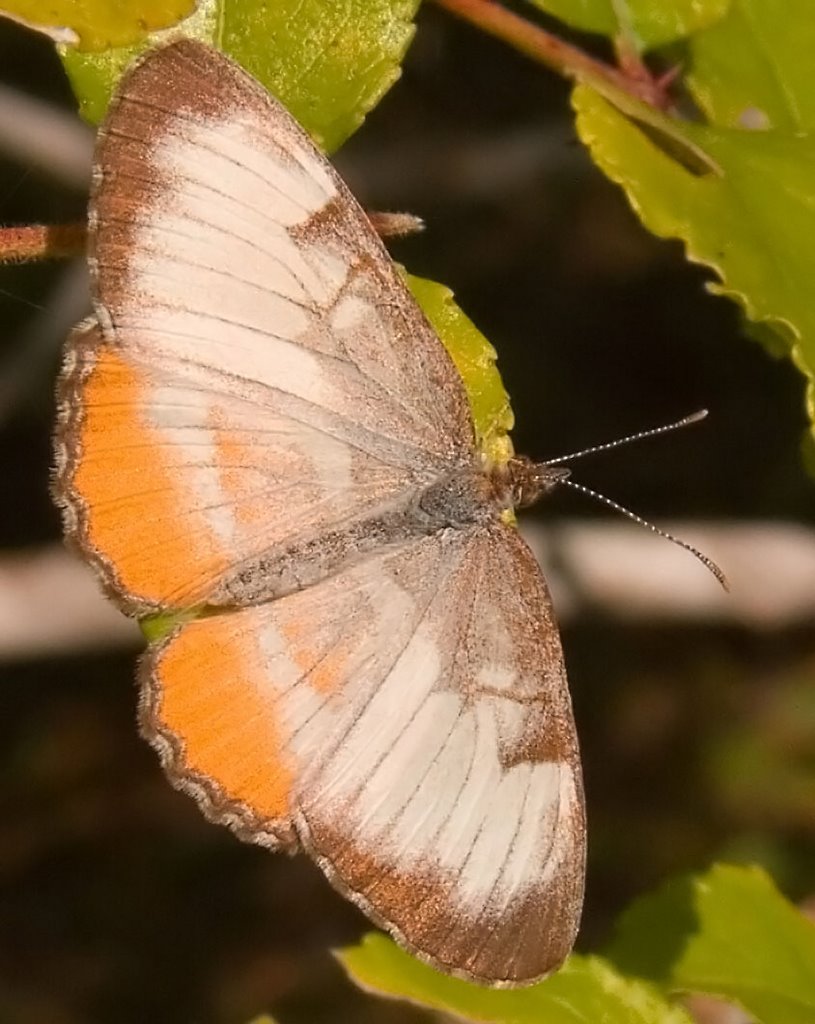
Common mestra, Mestra amymone. I mentioned in another post that blogger somehow muted the colors of a previous photo of this same species of butterfly. This one looks a little better.


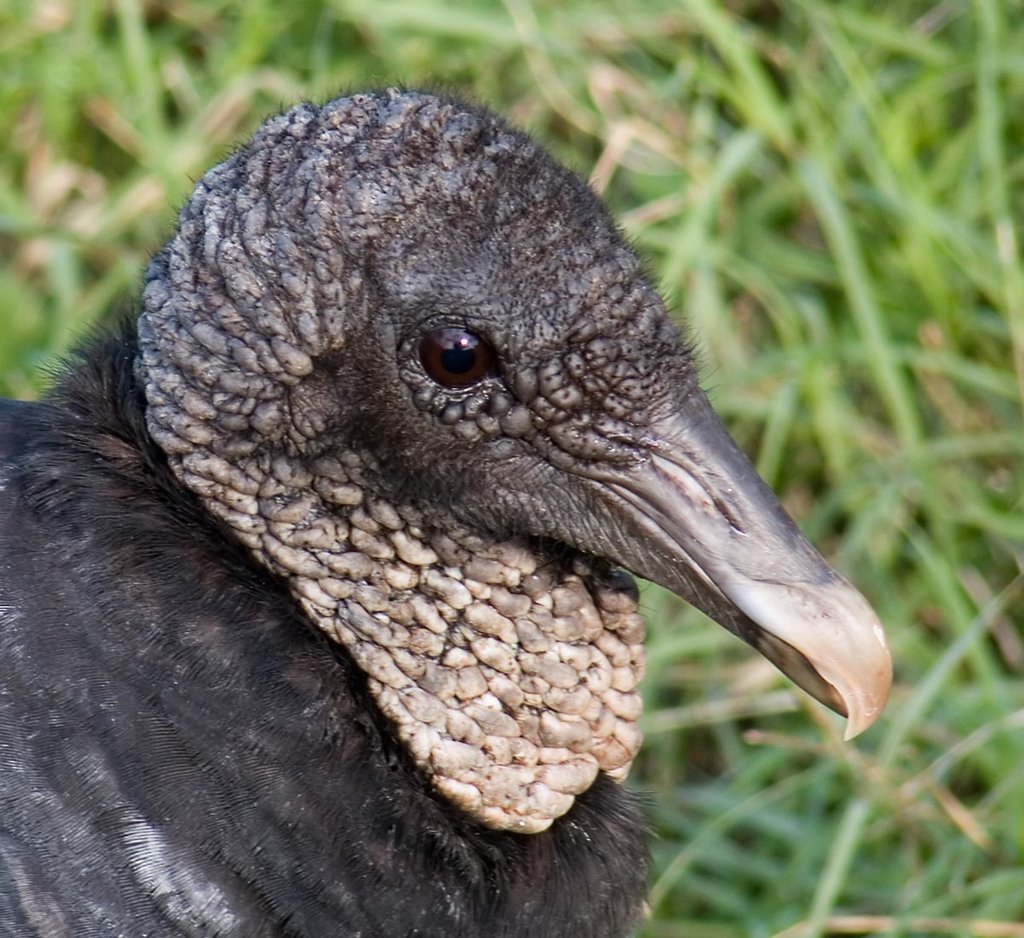
Black vulture. Vultures are more closely related to storks than to birds of prey. You can kind of see that here.


click photos to enlarge

Tuesday, October 24, 2006

Tuesday photo miscellany

Today I am afraid I will disappoint those visitors who come to this blog hoping for political diatribes, startling anecdotes, unfair and unbalanced philosophical viewpoints, or simply gossip. Maybe later.

As is usual lately, I've been out taking photographs. Unlike political blogging, nature photography works to keep the cortisol situation outside the danger zone. Here is a photo miscellany from the past few days.

Western ribbon snake, Thamnophis proximus. This species is highly variable. Our central Texas variety usually has a red stripe down the back, as this one does.


Fiery skipper, Hylephila phyleus, on a Palafoxia flower.


Black vulture landing at a vulture roost in the middle of Landa Park in New Braunfels, Texas. The roost is on an island in a small lake fed by Comal Springs, the largest natural spring in the state. It's quite a beautiful setting for a vulture roost. Cormorants and red-tail hawks also like it.


Turkey vulture overhead near Onion Creek


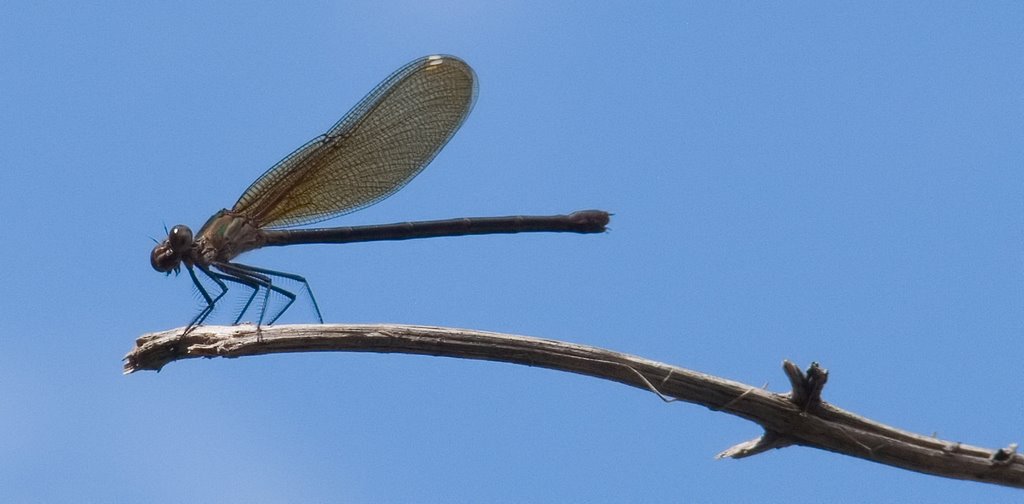
The damselfly that I mentioned in an earlier post, that I could not identify. I am reasonably certain it is a smoky rubyspot, Hetaerina titia. This species is also highly variable in appearance. I took a photo of one in Belize that was much darker.


Click any photo to enlarge

Friday, August 18, 2006

Home again

Just got back from Belize yesterday, but I'm too busy at the moment to write much about it. I'm helping my daughter get ready for her move to Baton Rouge for graduate school. I'll try to have a longer post and more photos sometime early next week. In the meantime here's a nice photo of a red-lored parrot taken near Punta Gorda.

(click to enlarge)

Wednesday, July 26, 2006

Random recent nature photos

As Texas became drier at the end of the last glaciation, we were left with some isolated wetland plants in unlikely places. We have a few surviving pockets of dwarf palm (Sabal minor) here in central Texas. These palmettos (from the Spanish palmito, little palm) are more typical of Florida and Louisiana than Texas. Here is a deer in the palmettos.


Here is a Needham's skimmer, photo taken at Port Aransas.


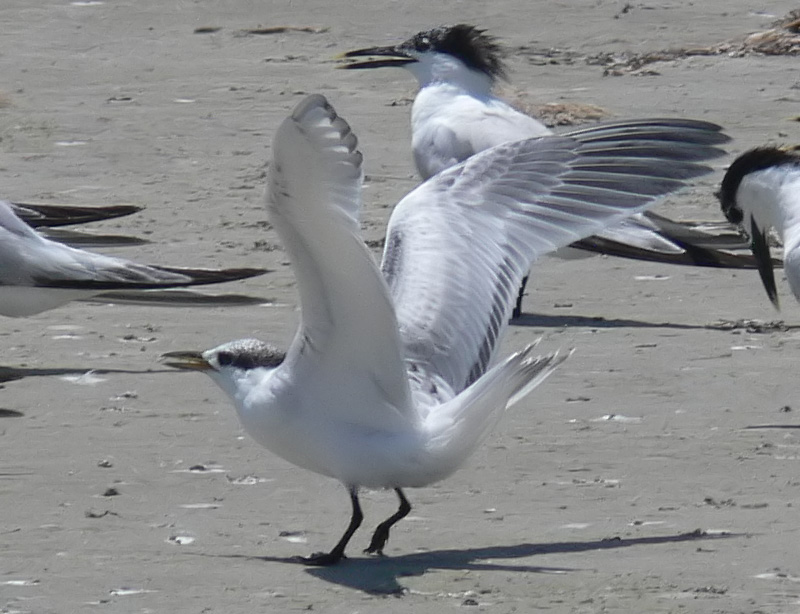
Sandwich terns at Port Aransas.


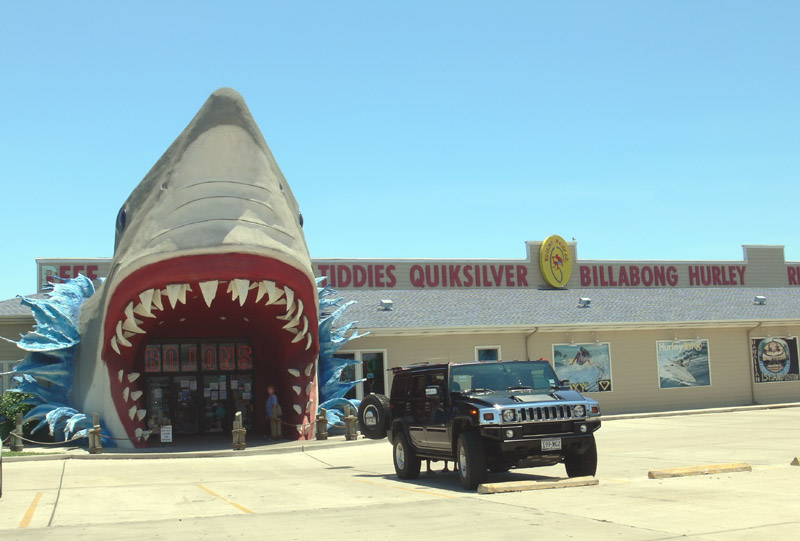
And here is the Texas great white shark, closing in on its prey, also at Port Aransas.


(click photos for larger view)

Friday, July 21, 2006

Birds and alligators at Port Aransas

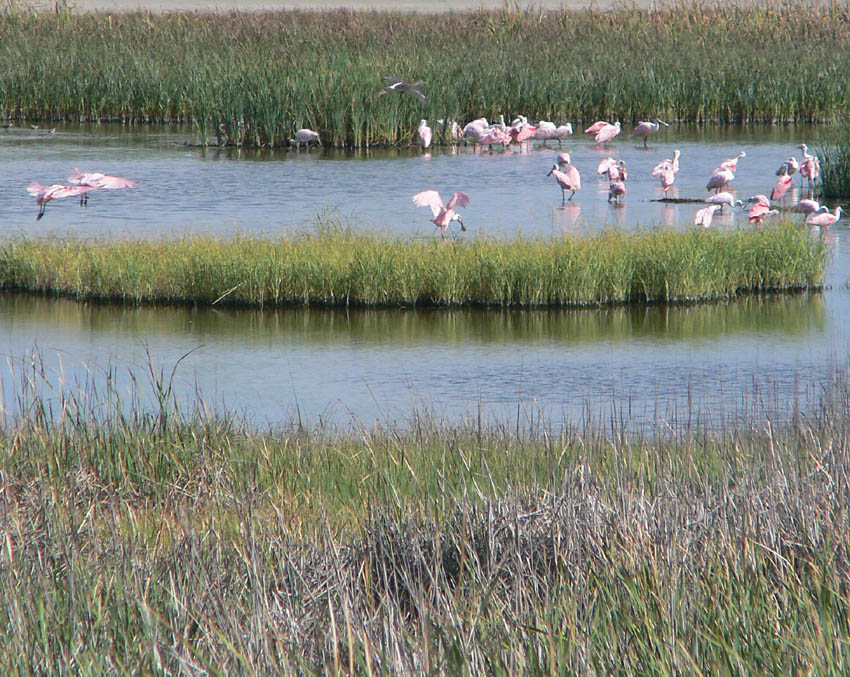
Once again I have failed to bring back any good close-up photos of the roseate spoonbills on the Texas coast. The picture below was taken about 300 yards out, and cropped and blown up. But it gives you a feel for how they look in the distance.


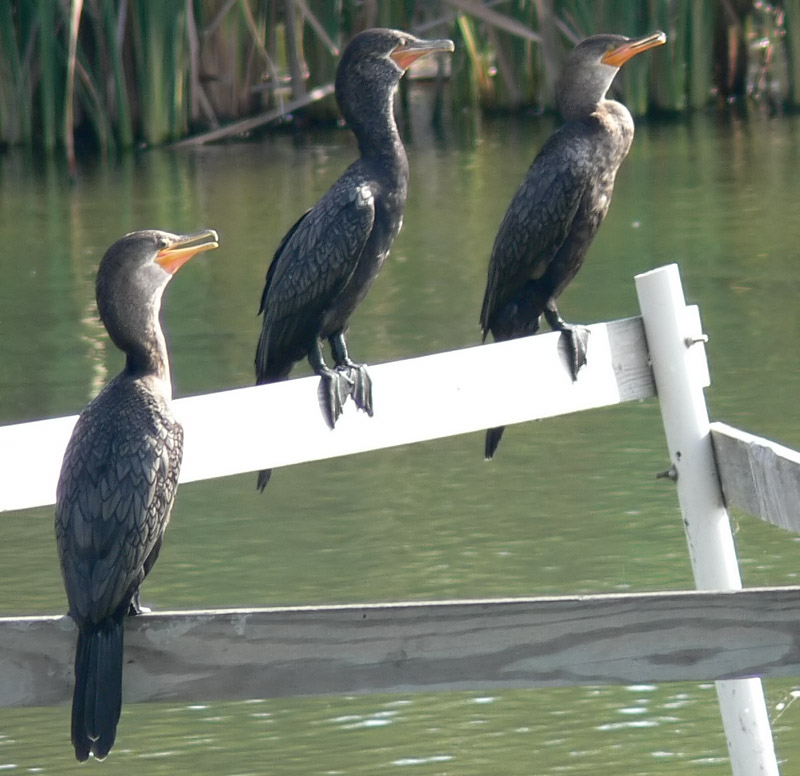
The cormorants were closer at hand, all engaged in active gular flutter in the heat. It looks like panting, but is actually a rapid forcing of air in and out of the mouth, so as to flutter the cheeks, or the bird equivalent of cheeks. The _Online Birds of North America_ says that it cools adult cormorants effectively, though young birds have to stay in the shade or die. I would have tried to use the video function of the camera to capture the fluttering movement, but I was hoarding camera memory for a multi-day trip. So at best you might detect a slight throat blur in the still photo.


Shortly after I took the previous photos, a large alligator, about 9 or 10 feet long, came swimming--very slowly, as alligators do--out of the marsh up to the place where I was standing with several other birdwatchers, a bird observation walkway that extends out into the cattails. The alligator gazed at us with interest, but we were out of reach. Alligators have large eyes. I had for some reason assumed they did not see well, but obviously they do. Here's a close-up of an alligator eye looking at the photographer.


Finally, here's a willet on the beach.


(click photos to enlarge)


Addendum: In response to a comment, here is an additional photo to clarify which way the alligator above is facing.