Sunday, April 29, 2007

The old Caldwell County Jail

My intention today was to take photos at a couple of old Mexican graveyards, but I ended up in taking pictures of an abandoned jail instead. (Notice that I avoided the cheap writerly temptation to say I ended up in jail. It's not often I have such discipline.) The old Caldwell County jail is in Lockhart, Texas, and was in use from about 1910 until 1982. It's a kind of jail you used to see in little towns all around Texas. They have mostly been torn down, and replaced with facilities no doubt just as inhumane, if not more so, but more comfortable for the staff and harder to break out of, allegedly.
The old Caldwell County jail, Lockhart, Texas
(All photos can be viewed larger on Flickr.)


This is actually a very small building. I didn't count the, um, beds, but I'd say the place could have held 15 to 20 very crowded prisoners at one time. The jailer and his family lived on the ground floor. The two floors above were where most of the prisoners were housed, and there was a place for a gallows in a stairwell space between these two floors. The gallows was removed in the 1930s without ever having been used, according to the woman who ran the museum now housed in the jail building. The fourth floor was a single room used for solitary confinement. It was actually a lot roomier and nicer than the other cells, and it had a view. For all the other cells, there was an observation corridor used by the jailer that stood between the cells and the windows so the prisoners could not really see out.

The museum is a local history museum with the excellent odds and ends that I have come to expect from local history societies--a sword from the Civil War that belonged to a local worthy, a saddle from the Chisholm Trail along with a gallery of portrait photos of Chisholm Trail cowboys, an Edison phonograph with a hand crank, someone's piano, a local doctor's turn of the (20th) century bedroom furniture, et cetera. I love stuff like that, and the museum proper--i.e., the ground floor jailer's quarters--was full of such things. But to my surprise, the public is allowed to go upstairs and through the old jail itself, which is pretty much unchanged since 1982, except dingier and the paint as now all peeling, and plus there is no bedding on the steel beds.

There was a photo in the museum of the first sheriff to run this jail, above a display case which held his brass knuckles. He was murdered walking over the railroad tracks between the courthouse, two blocks away, and the jailhouse. I speculated that the brass knuckles might have had something to do with the unsolved murder, but the museum lady seemed to think it was courthouse politics gone very severe.

In any case, you don't want to go to jail in Caldwell County. At least not then, and probably not now.

Photos follow:

Common room. What you see on the opposite wall is a sink, not a urinal. Both the second and third floors had very low headroom. It looks like they painted over graffiti with metallic paint every few years, but when the jail was abandoned they seem to have left the last wall-writings untouched.
Common room, Caldwell County jail


Beyond the door is a 2 person cell, about the size of a broom closet. There are two steel bunks in there. Some cells were bigger than others, leading me to remember that the jail was almost certainly racially segregated. I didn't ask the museum woman, but I suspect that the smaller cells were for racial minorities.
Two-person cell in the old Caldwell County jail


This is solitary, on the 4th floor. As I mentioned, it is more spacious than the other cells.
Solitary confinement cell, Caldwell County jail


This is the view from solitary.
View from Solitary, old Caldwell County jail


Jailhouse wisdom. This is actually not original to the graffitist--it's a quote from Bernard Meltzer, a radio show host from the 1960s through at least the 1980s. Maybe the jailer put it there for the comfort of the prisoners, though I doubt if jailers were encouraged to write on walls.
Jail graffiti, old Caldwell County jail


This graffito is more mysterious, but seems more authentic--as you can see it was first written in pencil and then recopied more legibly by the spider artist.
Jail graffiti, old Caldwell County jail.


This cell contained "El Vato," which might be translated as anything from "The Dude" to "The Badass." El Vato may have been the same as person as "a la pinta Arturo Acosta." "A la pinta" would mean " on the way to the pen."
El Vato, old Caldwell County jail


Finally, a jail corridor, for atmosphere.
Corridor, old Caldwell County jail

Tuesday, April 17, 2007

Remembering a mass murder

I was on the University of Texas campus on August 1, 1966, when Charlie Whitman started shooting people from the university tower. I had graduated from UT 2 years before, had lived in San Francisco after joining the Army reserves, and had just returned to Austin. I was unemployed, trying to decide whether to go back to San Francisco, and was hanging out in the student union (already a slacker.)

I heard banging noises which sounded like they were coming from the courtyard between the student union building and a library building. It was an odd sound, and for some bizarre reason my mind finally concluded it was someone cracking a whip there. Never mind that I had never in my time as a student seen anyone cracking a whip on the University of Texas campus, or anywhere else in Austin for that matter--it was somehow what I thought. And I thought nothing more about it for several minutes.

The whip cracking continued. I idly decided to see what was going on, and walked over to where I could see the courtyard. No whip cracker, but the noise continued. Someone came running down the student union hallway and said that a guy had been shot while riding a bicycle on the Drag, as the main street on the west side of the campus was called.

I heard somebody else say someone was shooting from the tower.

So, naturally, I went to the nearest window in the student union building where I could see the tower. I stood there in the middle of the window, along with several other people, and I could clearly see Whitman with his rifle. He was shooting over the tower parapet at that time. (Later, when police and deer-hunter citizens started shooting back, he began shooting from some port holes under the stone parapet.)

It should have occurred to me that if I could see Whitman clearly, he could see me clearly. But that thought did not enter my head. I decided to make room for others to gawk, and as I moved away from the window, Whitman shot someone who had been standing next to me. There was a big commotion, and all I could see was that someone fell down, people ran away from the window and they pulled the wounded person away. That wounded person lived.

Nobody stood in the window after that.

I didn't know any of the people killed, though one of them was the son of a professor I liked.

I was staying with a friend of mine who was a grad student in biology. He and his wife and I went to see a movie later that day, in the middle of the afternoon, a comedy, I think, though I remember nothing about it. I remember sitting in the dark in an old-fashioned downtown movie theater paying no attention to whatever was on the screen. Sitting in the dark for 2 hours watching a movie none of us paid any attention to seemed to make us all feel better.

The murders were very shocking to me--more so even than the one yesterday in Virginia, though probably that was because I happened to be present at the UT tower shooting. Still, I wonder if my impression that a crime like that was more unimaginable then than now, is true. That the mere fact that crimes like that are more imaginable, makes them more possible?

Saturday, April 14, 2007

Low-impact crusade

Over at Meanwhile Back at the Ranch Idyllopus is (gently) criticizing No Impact Man, whose blog which consists in a running journal of a low impact Manhattan lifestyle. As a Zen guy, I like paradoxes like the juxtaposition of "low-impact" and "Manhattan." Plus as a bonus (for me) no impact man currently has a somewhat bizarre discussion of Nansen's cat, an infamous koan. (Technical detail: NIM uses the Korean spelling of Nansen, I use the more common Japanese spelling. In present-day Pinyin it would be Nanquan.) NIM seems to think that the cat is the planet. It's unclear to me whether NIM considers that he is the Zen maniac who, as a test of the monks (metaphorically, one presumes) kills the cat, or that his critics are the killers, or both. That's very Zen.

I don't have any criticism of a low-impact lifestyle. I am pretty low impact myself, but it's a function of being Low-Income Man, plus maybe some remote Scottish stinginess inherited from my forebears, operating scarcely diminished at a remove of 300 years.

It seems to me very American of us to make saving the planet into a personal and moral quest, like NIM does. America, in our minds, should still be a City on a Hill, a new Jerusalem (never mind that the reality of America, from the beginnings till now, ought to disabuse us of such notions.) And if we are gonna be worthy of being among the elect, we must be strenuous in the pursuit of personal goodness. Who can object to that? I certainly don't. I like good people, and the low-impact crusaders are good people, by and large. As an old hippie, I have personal memories of earlier such children's crusades. I was a part of them. I still cherish the worldview we had. I am not cynical about the motives of the children. They may have been the finest children in the world.

The problem is that it won't save the planet.

The tragedy of the commons works on all scales, from an individual to an international level. Personally and locally, if I use less gasoline, it increases the supply, and lowers the price to Hummer owners, who drive more. Internationally, if the US as a nation decreases gasoline consumption, it increases gasoline availability for others, which leads to a decrease in the price of gasoline in, say, China, where in response they build more cars and highways, and drive more.

Likewise, Jevons's paradox is a related problem. William Stanley Jevons first noticed that the increased efficiency of Watt's steam engine over the earlier Newcomen engine led to more coal being burned, not less. It's intuitively obvious to us why this is so, but it was a puzzle to economists. Increased fuel efficiency of cars will not, of itself, lead to less gasoline being consumed, but will very possibly have the opposite result.

The only way to get circumvent these two tendencies is through governmental action (gas taxes, rationing, etc.) and, on a larger scale, international treaties. This requires a sense of emergency, like everyone had in world war II. We do not yet have such a sense of emergency. But, because the problem is genuine, we will presumably realize the emergency exists at some point, and be willing to act. The question is, of course, will it be too late. I wish I knew the answer.

(I was going to put in a coda that came out basically sounding like "in the meantime, to thine own self be true." But one of the reasons I have cut back on political blogging is the Polonius quality it had--to my mind at least. I laughed the other day when I read, in James Wolcott I think, a quote from someone else to the effect that what we really love about Hamlet is that Polonius gets stabbed. So, in the spirit of Nansen, I will now try to kill off Polonius for a few days again.)

Addendum: In the original version of this post, I had overlooked a certain grandiosity of NIM's blogname, and mistakenly referred to the blog's author as Low Impact Man. Sorry for the carelessness.

Arbitrary Zen photo
Zen photo for the blog

Friday, March 30, 2007

Friday cat blogging

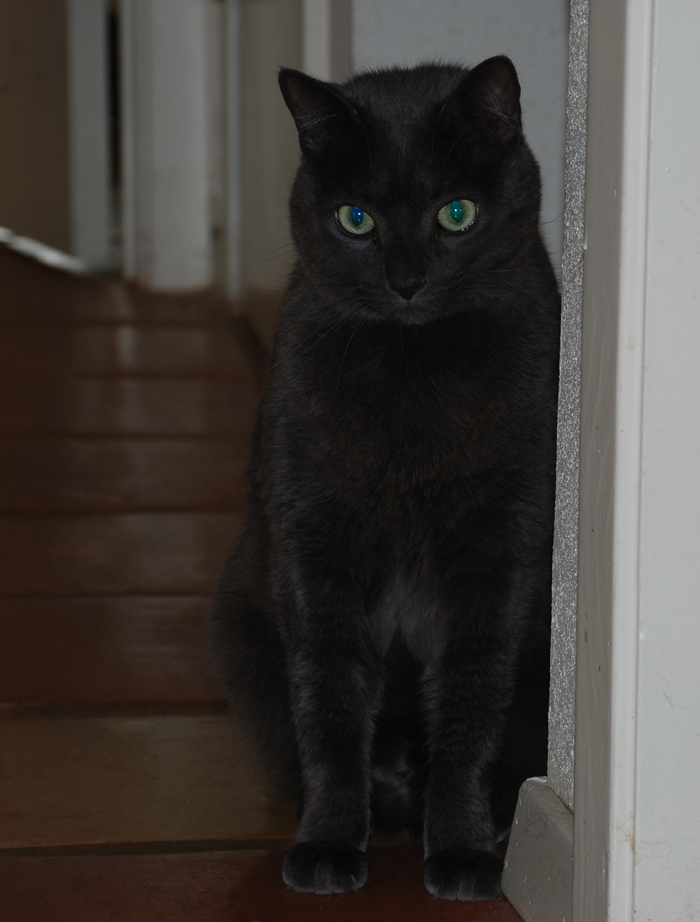
Gray on the dining room table. He likes this table because he can see out the front windows, and because it often has stuff on it that he can push onto the floor. Here it is unusually free of such objects, and perhaps he disapproves. But it is hard to read a cat's expressions.

Gray the cat

Saturday, March 17, 2007

Anti-war march in Austin, St. Patrick's Day

One of the first posts on this blog, 2 years ago, was a brief account of a peace march on the final Saturday of South by Southwest in Austin in 2005. SxSW as it is called, has become a big deal here, with crowds downtown all week long, musician hopefuls from all over performing at amazing hours (sometimes before noon), and music industry people, and talent scouts and hucksters and critics and writers and an amazing array of people who get their way payed to come here, and when they get here dress like they imagine Austin hippie-musicians do. It's a nice event, but those of us who live and work in Austin generally can't afford to go to many of the performances. There is also a SxSW film festival, as well as music, btw, but the films are earlier in the week. But I digress.

Sadly, the 2005 march did not bring the war to an end, nor has any march since then done so. But we can't give up on this, so today we had another anti-war march. This one was more in the spirit of SxSW than the 2005 event, because we had our own music. Word seemed to have gotten out that any musician was welcome and any musical instrument should be brought. And a lot of people who could actually play came to the march, plus, to make it democratic, so did a lot of people who brought pie pans to bang on with spoons.

But it doesn't matter, in a parade, because when the tubas and trumpets and trombones at the front were playing When the Saints Go Marching In (they did, actually, most of the way, real loud), the various knots of instruments along the length of the march would play something else because you can't hear what's at the front anyway if you are fifty yards behind.

So we paraded through the streets of Austin behind a brass band, mostly a tuba ensemble, but with any conceivable instrument being played somewhere in the throng, from pennywhistles to ukuleles to saxaphones to fiddles.

It's almost enough to restore your faith in America, several thousand people marching down Congress Avenue in opposition to the Iraq War, with a loud brass band and police motorcycles leading the way and the cops in general being nice even when people wandered out of the designated lanes (we were supposed to only use half of Congress Avenue, though we were allowed all of Sixth Street, which is already blocked off to car traffic anyway because of SxSW.) The crowds on Sixth Street, just as in 2005, were mostly bewildered, but strongly supportive. Many joined the march, since the parade had better music than some of the indoor venues, no doubt.

The parade ended, as before, on the steps of city hall, with more music.

More photos are on my Flickr page, which is where you will go when you click on the photos below.

Dancing in the parade
Anti-War March in Austin, St. Patrick's Day, 2007


Here we are on Sixth Street, the heart of Austin's music district
Anti-War March in Austin, St. Patrick's Day, 2007

Friday, March 16, 2007

Friday cat blogging

Gray looking out the kitchen window early in the morning. There's nothing out there.
Gray, the cat-2


Gray attempting to psychokinetically fill his food bowl by gazing powerfully at the servant
Gray, the cat--1

Tuesday, March 06, 2007

Joe Klein

Having taken a brief vacation from public affairs, I was unaware until today that a Time magazine columnist named Joe Klein had caused a stir in left-Blogistan by accusing us of being, well, left-wing extremists. Or rather, we "might be" left wing extremists if....[see long list below.]
(Now just how the fuck--to validate the last item on Klein's list--can a guy get what I presume is a nice meal ticket and a regular gig writing for a magazine found in every dentist's office, plus second-tier Sunday afternoon pundit status, with stuff like the following, which is absolutely no different in quality or thoughtfulness from riffs on "you might be a redneck if your porch caves in and kill four of your dogs, etc."?)

A left-wing extremist exhibits many, but not necessarily all, of the following attributes:
--believes the United States is a fundamentally negative force in the world.
Hmm. A majority of people in 20 of 26 countries polled by the BBC recently believe that very thing. This makes most Canadians (among many other nationalities) left wing extremists, eh, Joe. In fairness, Israel, Iran, and sometimes North Korea, are widely thought to at least occasionally surpass us in the negative force in the world department. However our current standing is at an all-time low world-wide, according to the pollsters, and a majority of people in the world outside of Poland and a few countries in Africa join me in being left wing extremists, it seems.

--believes that American imperialism is the primary cause of Islamic radicalism.
I guess I could believe that if I belonged to the Trotskyist faction of the SDS. Does Joe Klein think we are living in 1968? When was the last time you heard "American Imperialism" used by anyone but a stand-up comedian?

--believes that the decision to go to war in Iraq was not an individual case of monumental stupidity, but a consequence of America’s fundamental imperialistic nature.
See the previous. I have to say, though, that Joe is trying to slip a false dichotomy past the folks in the dentist's office--it's perfectly possible for a left wing extremist, at least in my case, to believe the decision to go to war in Iraq was neither of the above. How about you, gentle reader?

--tends to blame America for the failures of others—i.e. the failure of our NATO allies to fulfill their responsibilities in Afghanistan.
Um, what? I'm not following this one.

--doesn’t believe that capitalism, carefully regulated and progressively taxed, is the best liberal idea in human history.
Oh, Joe, Joe, how can I answer that when my porch just caved in and killed my dawgs? Jesus H Christ. How can stupid stuff like this even get printed? Should I try to take this question seriously? Should anyone? Suffice it to say that most of us LWEs can, indeed, think of better liberal ideas than capitalism, even capitalism barricaded by Joe's tendentious and somewhat cargo-cultish qualifiers.

--believes American society is fundamentally unfair (as opposed to having unfair aspects that need improvement).
I guess we LWEs are in the glass half empty camp. Sorry, Joe.

--believes that eternal problems like crime and poverty are the primarily the fault of society.
" Eternal problems," huh? Joe likes to telegraph the answers, doesn't he? Now Jesus did say a long time ago, and a little more eloquently than Joe Klein, that the poor are always with us, but I don't think He woulda said that Lazarus should have acknowledged that his situation was neither society's nor Dives' responsibility and gotten himself up from Dives' door and gotten his sorry ass off welfare.

--believes that America isn’t really a democracy.
I also believe that a hot-air balloon isn't an airplane. Who did win the 2000 election, anyway, Joe?

--believes that corporations are fundamentally evil.
There are many corporations. The Corporation for Public Broadcasting is probably not fundamentally evil. Walmart is perhaps more towards the powers-of-darkness end of the spectrum. Halliburton is, if not in league with the Devil, clearly in league with His servants in the White House.

--believes in a corporate conspiracy that controls the world.
Nah.

--is intolerant of good ideas when they come from conservative sources.
I think Joe needs to name one, so we can decide.

--dismissively mocks people of faith, especially those who are opposed to abortion and gay marriage.
Allow me a digression here. Where did the term "people of faith" come from? Whatever happened to "Christians" or "Jews" or "Baptists" or "Seventh Day Adventists" or "members of a polygamous splinter faction of the Church of Jesus Christ of Latter Day Saints"? My point being that many "people of faith" do not have opinions on abortion or gay marriage that anyone would want to mock. Some, however, do. To try to gather all the people of faith behind a criticism-proof protective shield constructed as an analogue to "people of color" is to obscure some important distinctions that we LWEs continue to make, living as we do, in the ruined remnants of a reality based world.

--regularly uses harsh, vulgar, intolerant language to attack moderates or conservatives. Well, what can I say? Though I don't want to be vulgar about it, I do feel a little put out that I have wasted a half hour of my time unburdening myself of the certain exasperation I feel when I run into stuff like Mr. Klein's shameless rhetorical defecation on captive readers who already have enough trouble, like a root canal and how to pay for it.

Thursday, February 22, 2007

Announcement

No, I am not closing down this blog. But regular readers will at this point benefit from knowing, if they have not figured it out already, that I will not post as often as I used to. Probably coming by once a week will do, or even once a month.

I think bloggistry probably has probably been here long enough to have established a standard blog trajectory. Blogs begin with enthusiasm, the blogger having lots to say. Later it becomes more like a job, with a sense that people are counting on you and you need to say something significant--or at least put some words out there. After that comes the realization that it's not a job, and indeed that nobody should be (and hopefully nobody is) waiting in suspense for your next post.

The first year of this blog was mostly anecdotal and personal, consisting of recollections and reflections about people and places I have known. The second year has been sustained more by political outrage than anything else. I suppose the political outrage still exists, but there is not a lot to say about the Regime that has not been said by sane and reasonable people many times over.

I feel less compelled than formerly to write about politics, simply because I am either repeating myself or amplifying, not necessarily to advantage, what others have already said--not that that will be guaranteed to shut me up, given the always astonishing ability of Republican officeholders to descend to new depths of foolishness, reckless folly, and shameless deceit in ways that even now astonish me. Whenever I am astonished I tend to sit down at the keyboard and write.

Lately I have spent more time taking pictures than I have writing. I am well aware that whatever native talents I have lie more in the realm of words than picture-taking, but sadly--or it would be sad if either were more than a retirement hobby--I greatly prefer photography to writing. I always have.

Years ago, I had a girlfriend who, after knowing me a few months, observed that I was obsessed with seeing things--that I had a more binoculars than your average compulsive birdwatcher needs or wants, several telescopes, a drawer full of hand lenses, and of course a camera, though I could not afford a very good one. I took one or more of these instruments out with me far more than I needed to, like going to the grocery store with a Hastings triplet in my pocket, not that I had any real intention of examining the produce with it, but just because you never know when you might want to look at something up close.

She thought this was odd. Maybe it is.

Anyway, since retirement I have rediscovered an interest in photography that had somehow lapsed in the press of job and family life in the 20 years or so before I retired.

As I mentioned I am not all that good it it, but I find myself very much looking forward to a day of taking photos, and regarding even an hour or two of sitting down to write a blog entry in something like the opposite way--which is not a good way to approach a blog.

So this is a long way around of saying it may be a week, or a month even, between blog posts--whatever the frequency may turn out to be of being struck with something that seems important to say, and a desire to say it.

In the meantime if you wish to check in on my life, or that part of it I am taking pictures of, which at the moment is mostly outdoor stuff, nature photography, but also contains occasional records of trips and social events, you can go here to see photos arranged by date, or here to see them arranged by subject.

Thursday, February 15, 2007

Thursday buzzard blogging

A couple of shots of Cathartes aura.

Checking me out
Buzzard-1


Flying away, since I seem to be in good health
Buzzard-2

Monday, February 12, 2007

Is Iran next?

Before we rush off to the next Republican war, we should take a moment to think about the one we are in.

I suspect the claims of Iranian interference in Iraq are most likely lies, given the credibility of the people who are making those claims, and given the ongoing lack of evidence. But that is not and should not be the issue. The issue is that we have no business in Iraq in the first place, and, hence, should get out.

What is important to remember is that we have no legal or moral or national self-interest basis for being in Iraq. None.

We are engaged in a war now universally acknowledged to have been founded on lies. We are not defending our "homeland" from Iraqi aggression. Iraqis were not involved in 911. Iraqis had no weapons of mass destruction to threaten its neighbors, much less us. We are not bringing democracy to the Iraqis. We are not bringing them security, but civil war instead. We are not bringing them prosperity. We are not even securing a reliable supply of oil for our SUVs, as cynics believe is the true purpose of the war. (Oil is sold on the open market. If we somehow "secured" oil from one region, there would simply be more for sale to the rest of the world from other oil-producing regions. This isn't rocket science. This is economics 101.)

The latest, last, and least of reasons given by the Administration and its cheerleaders is that to leave Iraq would be "defeat" and defeat would harm our country. What crap. We were driven out of North Korea, and our country prospered. We were defeated in Vietnam, and we survived as a nation. And with regard to Vietnam, we obviously would have been better off never going there to start with, and, once we did go there, would have been better off leaving sooner rather than later. Nothing could be more evident.

Anyway, it follows from the fact that _all_ the reasons for going to war in Iraq were and are untrue, that we now have no justification--at all-- for being there at this moment.

It also follows that the Iraqis who choose to resist have a perfectly legitimate reason to defend their country against a foreign invasion.

We forget this. We have illegitimately (and, under international law, illegally) invaded their country, using outright lies as a pretext, and are now occupying it by force. People in any country, under such circumstances, might be expected to fight back. We would normally accord legitimacy to such resistance.

Except, of course, that ours is the invading and occupying force.

If they have good reasons to defend themselves against an invasion that no one now believes had any truth behind it, then presumably they would have the right to call on assistance from others. Whether various factions of the Iraqi civil war have done this I have no way of knowing.

I would be far less disturbed at learning that they did, assuming that the Administration and its servo-repeaters in the press are, God help us all, actually telling the truth at last--which I tend to doubt--than at the ongoing and daily injury our continued presence in Iraq does to our honor as a nation, to goodness and decency itself, to the harm it does to our own soldiers, and the even more tragic injury it does to the people of Iraq, when 650 thousand of them have already died in our war and no end of the carnage we have brought them is in sight.

And it increasingly looks like the only way out of this debacle the Administration sees is to march into Iran--citing, of course, provocations.

That's not much of a plan.

Friday, February 09, 2007

Thursday, February 08, 2007

Self portrait on my 66th birthday

My daughter would have wanted me to do something to celebrate, but she is in Costa Rica.

Waiting for the self-timer
Self-portrait on my 66th birthday

Monday, February 05, 2007

Salon on spanking

In an article in Salon this morning, Eilene Zimmerman goes off on a proposed California law against parents hitting children. The legislation is highly unpopular in California, and evidently has no chance of passage.

But even though it won't pass, it "raises the question of how far the government should go in telling parents how to raise their children" (not to mention providing material for an article, always useful for a writer.) Ms Zimmerman sees a slippery slope yawning before her, though, as it happens, many civilized countries have such laws. Sweden is one. But it seems Sweden is not a popular role model for Americans, law-wise.

The author's view is that we already have laws against "physical abuse," which should be sufficient. Physical abuse is legally defined as assault which leads to physical impairment. In other words, if you don't break any bones or leave any bruises you are home free, as a parent who hits children. And the author's implicit, but somewhat conflicted, view is that it should remain that way, although, being a capable writer, she does not place her own opinion on laws against hitting children in the same paragraph as her mention of physical impairment.

My own feeling is different from hers. It's true that I am not in favor of major, punitive criminalization of hitting children--we are already too punitive as a nation. That is part of the problem. But certainly making it a misdemeanor punishable by, say, a fine would be A-OK in my book. In Texas you can beat your child in public and get away with it, no problem, but if you forget to get your car inspected on time you will owe the government $135. (I have no problem with the latter, by the way.)

Underlying the article, it seems to me, is a fundamental notion, deeply rooted in the American psyche, of the legitimacy of inflicting physical pain on people--a notion that is really not questioned by the author, though when her American psyche encounters another world-view, it does recoil in amazed horror.

How are we going to teach our children to cross the street safely, if we don't whack them to alert them to the danger?

To digress a little bit, as part of our national character, we don't much question things like the fundamental police power of enforcing "compliance," at least by non-lethal means. In other words, if you question authority you can expect, and should expect, to get into, um, compliance, through somebody putting some pain and suffering on you, if need be. As far as most Americans are concerned, the taser is fine and dandy for that purpose, a big improvement over the bullet or the billy club. But this is territory that Ms Zimmerman does not explore.

One of the proponents of the California legislation mentioned in Zimmerman's article is a law professor with the unfortunate name of Thomas Nazario. (You can already see it coming, can't you.)

Zimmerman declaims in passing--without seeing any irony in her own contribution to the public discourse--against America's saturation with opinion on child-rearing, which produces, in her view, massive parental anxiety. I suppose if you are anxious about not being able to continue hitting your disobedient kid, there may be something to that. She yearns for a simpler time, when spanking was spanking, not child abuse.

Shortly into the second page of her article, she quotes someone calling the proposed California legislation fascist. The word "fascist" appears five words away from the name "Nazario," who, as I mentioned, is a proponent of the law. I told you that you could see it coming.

We see here the utility of projection in american politics--as for example Rush Limbaugh's calling women he disagrees with feminazis, while if we pause and search for irony, and scratch the surface of Mr. L himself we might find something close to the very essence of a real Nazi, un-adjectively-modified. Or perhaps we might merely find a huckster with no principles and a shrewd view of those of his audience. In any case the dogs are loose now; fascists are running in the street, which is where we are at the end of the article, though the author's internal conflict over her own position puts in a surprise appearance in her final paragraph.

"Should any of us be doing these sorts of thing? Of course not" she says, of hitting children. But she doesn't want to be arrested for it, if she does it.

And I don't want her to be arrested either. What do I want? I guess I want her to go back to her own memories of being spanked and hit as a child, and see if she is really as unimpaired as she thinks.

Thursday, February 01, 2007

Spitting and baby-killing

A new story of good and evil is making its way through the right-wing blogs, and, of course, has gotten play on Fox News. It is, in essence, this: A disabled Iraq-War veteran named Joshua Sparling, who was a counter-protester at the recent anti-war demonstration in Washington, says he was spat upon, called a baby-killer, and threatened with clubs by maddened peace-demonstrators.

Some have questioned Mr. Sparling's story. He has in the past made at least two public claims--which have separately gotten into the news--of having been menaced or abused by people opposed to the war, which, combined with this, certainly seem to make him a statistical outlier. But who knows--some people get struck by lightning more than once.

What is more curious is the way this story immediately gets into print and gets air play, and becomes an issue with the right wing. It seems to have visceral appeal, as did the Vietnam era urban legends of peaceniks howling insults at returning soldiers, and spitting on them.

Spitting is interesting. Americans regard it as a sort of ritually contaminating gesture, something unclean (though, oddly enough, relative strangers in America regularly exchange spit, sometimes on the first date). Spitting on, or at someone, is not how Americans would normally disagree. And it seems to me that there is an element of unmanliness in the gesture, when and if it occurs, as well as un-Americanness. A red-blooded American man would challenge you to a fistfight, perhaps, but spitting implies, somehow, spit and run. John Wayne would not do it--it's not the Code of the West.

I have to admit that the reappearance of the Vietnam-era epithet "baby-killer" puzzles me. If I remember right, the term "baby-killer" entered public consciousness after it became known that Lt. Calley and his platoon did indeed murder about 500 civilians, many of them children. In other words, there was a historic event that led to the use of the term--and I think it was used--in some of the more extreme screeds of the SDS and such groups. Whether or not the phrase was ever actually uttered as an insult to individual soldiers in airports and bus terminals, as claimed by the right, is of course, open to question.

In any case, the present war lacks such a context. The atrocities that have entered public awareness have more to do with the torture of adults than the killing of children.

But the incorporation of spittle and supposed name-calling into stories of good and evil seem to me spring not from context or plausibility, but from a kind of psychological projection. These tales seem to appeal to people who love to hate their enemies, but do not wish to acknowledge that hatred; people who consider those with whom they disagree to be deadly enemies, not political opponents.

Friday, January 26, 2007

Friday cat blogging

Gray opens one eye to see what is going on.


plus Friday zoo blogging available
here.

Friday, January 19, 2007

I haven't been out much...

...because of several days of rain followed by an ice storm. It is still cold (for Austin) and muddy--not good for trekking around outdoors. But I have been keeping my bird feeder filled, and the birds come to me. This bird, a downy woodpecker, is not at the bird feeder but is busy investigating my fig tree, which, no longer encased in ice, kept the bird interested for 15 minutes, which must be a week in downy woodpecker time. I think the ice may have split the bark to reveal some food source--in any case I don't recall seeing a woodpecker in the fig tree before.

Downy woodpecker
Downy woodpecker

click for larger view

Wednesday, January 17, 2007

Obsolete travel notes--Honduras before the Hurricane, part 2

Another in my obsolete travel notes series. Travel accounts tend to become out of date quickly, but I have found that I actually prefer travel writing that has arrived at great obsolescence, and describes places that you will never see, or that cannot be seen anymore by anyone, the past being a country difficult of access, to borrow the cliche. I usually take notes when I travel, but only write up a narrative years later, when I can sort out what part of what I saw has fallen away from the commonplace world as I know it, as--ideally at least--some of it may have done.


The Mainland
Bustling, raw and ugly, San Pedro Sula looked like global-economy hell. If you took Odessa, Texas, tripled the population, narrowed the streets and filled them with a few thousand badly tuned used school buses, and allowed only whimsical garbage pick-up for six months, you would have something like the same civic charm. But there was a certain prosperity. It had the raw vigor of rich and unscrupulous people on the move and poor but industrious people trying not to go under.

We had gotten off the plane from Roatan Island, where we had spent Christmas. (Honduras before the Hurricane, part 1) It was still Christmas in mainland Honduras, actually--Christmas in Latin America continues until January 6th. We had to spend a day in San Pedro Sula to await our baggage, which did not return with us on the plane from the island, for unknown karmic reasons. So we ate at the Hotel Skandia lunch counter. Prosperous, possibly wealthy, Hondurans, dressed rather elegantly, were passing the time there, leisurely, a no-hurry latin concept of lunch settling out of the otherwise get-rich-quick capitalism atmosphere for two hours in the middle of the day.

We walked around seeing the sights, and went into the cathedral. It had been built in the 1950's, but looked much older. Inside, they had erected a festive fifty-foot thatch Christmas tree over a framework of iron, behind the main altar, and installed a creche below it. A few faithful, on Tuesday in the morning, knelt praying. One man, in front of a big crucifix in a side chapel, had his eyes closed and his hand on the life-sized-Jesus' bare thigh. The man's family knelt around in a semicircle, all of them praying. Had we thought, we would have prayed for our safety on our bus rides.

Busride to Copan. Mostly local passengers, but a few tourists. A thuggish-looking German let Eve use his large, sharp, hair-trigger switch-blade knife to peel her apple. His girlfriend was very delicate and beautiful. Both carried enormous packs on to the bus, and heaved them in a big stack in the back, where the space was contested by men carrying bushels of fruits and vegetables bought in the market in San Pedro Sula to their fruitstand in Copan. One of the market guys conversed with Kay about his life's ambition to go the US to work and earn enough money to buy a used Toyota pickup and come home with it so he wouldn't have to ride the bus every morning with his day's inventory, competing for space with more frivolous travelers. Let us hope that by now he has achieved his goal.

The forest along the road as we went upcountry had mostly been cut down for agricultural purposes, just as it had been in Mayan times, but now, as then, they left occasional huge whitebarked trees in the fields. One kind was called Ceiba, another kind I can no longer find the name for. The reason for leaving these trees uncut in the field is said to be religious.

The bus ride was long, and as we settled in and started to doze off, "Bang! WHOCKAwhockawhacka!" Everybody woke up. The bus was tilting and careening back and forth across the road as it slowed down. Blowout. The bus finally weaved to a stop. The bus crew, 2 men and 2 boys, jumped out and changed the tire in ten minutes. The driver displayed his impatience by taking off his sunglasses.

Town of Ruinas de Copán (formerly San Jose de Copán) is on a low hill overlooking the river that flows past the archeological site. The Mayan site is a quarter mile upstream. The streets of the town are cobblestoned. The Spanish woman who runs the hotel wanted her 25 Lempiras per person in advance. Cold shower. Cold showers in the tropics are just as cold as anywhere else. We took our laundry to a friendly American woman who lived up the steps (one very vertical street ends in steps) around the corner. She had been living there several years, and seemed to have found a niche for herself. A laundress in Ruins of Copán. What strange lives you encounter, when you travel.

Copán. The guides attaching themselves to shoals of wandering tourists were somehow central to the odd theme park atmosphere, making it a little hard to imagine the human sacrifice narrative they were promoting, even if the big stones sitting like giant turtles in front of the pyramids and statues were indeed used to spread-eagle sacrificial victims to cut their hearts out with flint knives. We were walking around in a pleasant, well-mowed archeological park with little boys selling replica figurines all around us. Big stacks of stone skulls, however, looked ominous even in their present setting. Was the discoloration of the stone altars blood, or weathering, or something painted for touristic purposes? The Mayans did practice human sacrifice, but generally only of captured kings or generals. Think Saddam Hussein and his men, for a modern analog.

The second and third squares of the park were less restored than the first, and free of roving guides. The stonecarving looked to me like something Chinese.

We walked to the river. We found some Germans camped there; the German guys had gone into town to get supplies and drinking water, leaving a statuesque young woman who was unselfconsciously wearing a tiny bikini and tending a fire. Campesinos hoed weeds in a nearby field and ogled her, as were two guys covered with mud, squatting in their underwear digging clay in the riverbank to make the Mayan replicas to sell to tourists. A bunch of girls on the opposite cliff, dressed very conservatively, giggled as they looked down at the young German woman.

Bus to Gracias. A woman paid the bus driver an egg for a ride of a few miles.
Castor beans grew commonly along the roadsides; I never got around to asking why. Purple morning glories twined along the fences. Poplars shimmered along dry creeks. Tall white daisies, high as sunflowers, clustered along the road. We saw an occasional spectacular orange-flowered tree that I found out, by inquiry, was called llama del bosque, "flame of the forest." That was the name of a restaurant we had eaten at in Copán.

We passed a town called Flores, meaning Flowers, on the dirt road stretch of highway on the way from Santa Rosa de Copán to Gracias. Flores was a nice-looking town, except for the town square, which was not only barren of flowers, but barren of almost anything. No vegetation, statuary, or benches--nada. Flowers everywhere but here.

In Gracias, we ran into a Dutch woman ("La Olandesa") who was friendly and told us about the town. She later took us to some hot springs. She had come to her little town as part of some Peace-Corps-like program, and then she stayed on after the program ended, as a restaurant owner, daredevil jeep driver, and "women's advocate" (her words). She was full of smiles, spoke Spanish and English, in addition to her native Dutch, and had a cheerful female Honduran sidekick who seemed to be a sort of partner in the restaurant and the women's advocacy. Both women had buck teeth and intelligent faces. La Olandesa was very social, and a crowd gathered in the evening at her restaurant, surrounding her with gossip and persiflage. Enjoyable company.

Next day, La Olandesa drove like a madwoman to get us to the hot springs, down a chuckholed, spinal-compression-injury rocky road two or three miles. The hot springs consisted of several rocked-in swimming holes. The water was warm, not hot. Big broadleaf trees shaded the place, and a Flame of the Forest. We stayed there, for an hour or so, floating in the warm water, till the jeep came back. There was a little concession stand, a few Hondurans soaking in the springs. People were rubbing a green clay on their faces to improve the health of their skin, they said.

Cloud forest. We got a ride in the back of a pickup from some guy who took us to the cloud forest--La Olandesa's jeep was now in need of repairs. The clouds were nearly down to the town level. We soon got up above the pueblo, and looked down on the cloudbank bright in the sun that covered the village. From the park entrance we hiked in for an hour and a half, through trees like Colorado with a tropical understory. There was a coffee field by the visitor center. A friendly dried-up and sinewy woman in a plain dress, with two wild skinny dogs loping along ahead of her, came striding up the trail and opened the center (which was really a small, abandoned-looking wooden house) and showed us a map of the park. We walked along the stream, which was pretty and clear. I got a drink out of it, assuming the water was OK, which it was. Three colors of mint grew there, blue, purple, and white, the latter two with a menthol smell. Sycamores grew orange-leaved like fall maples next to the stream, under the pines, along with lots of tropical broadleaf trees. On the walk back, at the level of the park entrance, I noticed a sometimes-tended banana field along the trail, possible belonging to the park attendant.

Oak tree leave shone like metal in the sun.

We didn't have time for a more extended stay, and we had a plane to catch in San Pedro Sula. We took a quick meal in a small restaurant in Gracias with velvet-painted Elvises on the wall, before leaving on the bus. (What's the plural of Elvis--"Elvi," maybe?) Bad Elvi.

The bus back to San Pedro. We had noticed that an assistant usually started a bus driver's engine, then when everything was ready for the great man himself, the bus driver would ascend to his seat, with ceremony, place his sunglasses before his eyes, and ease the bus into gear. A bus driver would no more dream of wearing a seatbelt than a bullfighter would wear kevlar armor. This driver was a burly man with menacing handlebar mustaches, whose driving pressed every advantage, who passed at high speeds on on blind curves and hills. I believed that the guy would someday go out in a blaze of glory. Fortunately he did not do so that day. He got us to San Pedro Sula nearly an hour ahead of schedule. I had been fearful that my failure to pray in the cathedral would cost us dearly, but someone else on board must have prayed enough for all of us.

Friday, January 12, 2007

The magic touch

It is never a good thing to have a president on a mission from God, as we see with Mr. Bush's chutzpotic (I have been waiting for a chance to fuse chutzpah and despotic into a single word, and our President, sadly, gives it to me) unilateral decision to raise the stakes in Iraq. Bush has always been able to brazen his way out of trouble, but the last time it really worked flawlessly for him was the 2000 election, when he gambled that he could take office by simply acting as if he had won. And sure enough, he has been living in the White House ever since.

So at this point I think this habit is hard-wired into his administration. A message from the American people, delivered by the last congressional elections, can't compete with the message of past successful effrontery. He believes, and has believed all along, that magical thinking creates its own magic.

What his magical thinking envisions, and what he may have in fact created, is a situation where the country may be boxed in, and either we have to accept what everyone must regard as catastrophe--in this case, coming home from Iraq with nothing to show for it but 3000 American dead, 650,000 Iraqi dead, plus civil war and anarchy in a failed state we have left behind--or double down, and widen the war to Iran, which is what I think he wants to do, and, unless he is deterred by Congress and the public, what he is probably going to do.

The fact that it seems insane should not make us worry any less. Look at his history. And look at the signs. We have a recently published story--and perhaps it is not just based on rumor--that we have given the Israelis the green light to conduct a nuclear strike on Iranian nuclear facilities. The Israelis have denied any such plans, but of course they have denied for years that they even have nuclear weapons.

We have our raid a couple of days ago on an Iranian consulate. We have ramped-up saber rattling, demanding the Iranians stop supplying the insurgency, and a plan to place more American troops along the Iranian border. (The absurdity of the idea of a largely Sunni insurgency being funded and supplied by Iran is a fine point that will be lost on a public, and possibly on Congressional foreign affairs oversight, where an important committee chair does not even know the difference between Sunni and Shia.) We have aircraft carriers being deployed to the region, and Navy aircraft obviously are not going to help secure the streets of Baghdad. So what are they for?

Allow me a moment of dystopian imagination, here. (Hopefully it will turn out to be as mad as George Bush and all his march-hare neocons.) If his plan is to box us in to a situation we can't retreat from, a military confrontation with Iran certainly fits the bill. Once that spirals out of control, we are committed for another few years--and we certainly don't want to change ruling parties in the middle of a war, do we?--until that war becomes, itself, another disaster, larger and uglier and more dangerous for both our security and our civil liberties even than the Iraq war has been.

I think that's were George Bush imagines his legacy to lie. He thinks that God will pull this thing out of the fire for him, and if it takes a bigger fire for God to consider personally stepping in, well, hey...

Thursday, January 04, 2007

George Will and the minimum wage


George Will, a syndicated--and no doubt highly paid--conservative scold, tells us, in his column today, that raising the minimum wage to something higher than $5.15 an hour is a bad idea. His evidence is that the New Deal prolonged the Great Depression. Well, that's not his only evidence, but that's what he leads with, which indicates the quality of what is to come.

Will, he of the perpetual dyspeptic scowl and tightly buttoned collar (could it be that his mood, if not his conservatism, could be helped by loosening his tie?) goes through the usual litany of falsehood and half-truth to make his case, but it seems scattershot and perfunctory. It's hard to wear what appears to be a Rolex and get too indignant about the laboring classes making too much money. (Well, hard it may be, but his duty is clear. So he manfully sets about it, frown firmly in place, as always.)

Mainly, he says, the poor don't need a higher minimum wage. The poor already make more than the minimum wage, he says. (Six dollars an hour, perhaps? And that because of _state_ minimum wage laws, of which Mr. Will, as it happens, disapproves. Ah, well.)

Having said that the poor don't need higher wages, he then adds triumphantly that most of the workers getting the minimum wage are not poor.

That's true pretty much by definition. If you tried to live by yourself on the minimum wage, you could not pay the rent, much less eat. So you have to live with others. Poverty is defined by the government in terms of households, not individuals. So if you live with one and a half other minimum wage workers, you are above the federal poverty level, which is almost as much of an indictment of the government's definition of poverty as it is of Mr. Will's intellectual integrity.

Other parts of Mr. Will's Heritage press release re-write do not cohere well. For example, he tells us that higher minimum wages will increase high school drop-out rates, luring unwary youths with the promise of easy money. He also tells us that higher wages will increase unemployment.

Now, as it happens, this last factoid has been shown in to be untrue in the aggregate, but, alas for Mr. Will's thesis, true for one subgroup of workers--part time _student_ workers. In other words, high school students are about the only class of people who find it harder to get work when minimum wages are raised. Mr. Will ignores this fact when claiming, on the word of two un-named "scholars" that school enrollment will drop 2% if we raise the minimum wage 10%.

You can't have it both ways, George.

But, actually, conservative apologists for the stacked deck and the screwing of the poor, regularly do have it both ways, simply because they do not care about the truth or consistency of what they utter or write, any more than about compassion or fairness, much less equality (a word that probably makes Will shudder. Everybody can't have a Rolex, right?)

When I imagine Mr. Will, above, wearing a paper cap and a work-stained apron, instead of his suit and tie, behind the counter of a franchised fast food place, it is not out of ill will or unfriendliness, but as imaginary but nevertheless heartfelt acknowledgment that he, over and above other workers would be, on the basis of his merits alone, one of the two thirds of minimum wage workers who, he says, get a 10% raise inside of year.

The free market, as Mr. Will says, must be given its due.

Three views of an orange-crowned warbler

This warbler was rustling in some leaves behind my house. It seemed very busy, and let me get close enough to get some good photos. Although I couldn't tell as I was taking the pictures, it seems to have found a small gelatinous delicacy to eat.

Searching
Orange-crowned warbler 1


It finds something
Orange-crowned warbler 2


...a mid-morning snack
Orange-crowned warbler 3